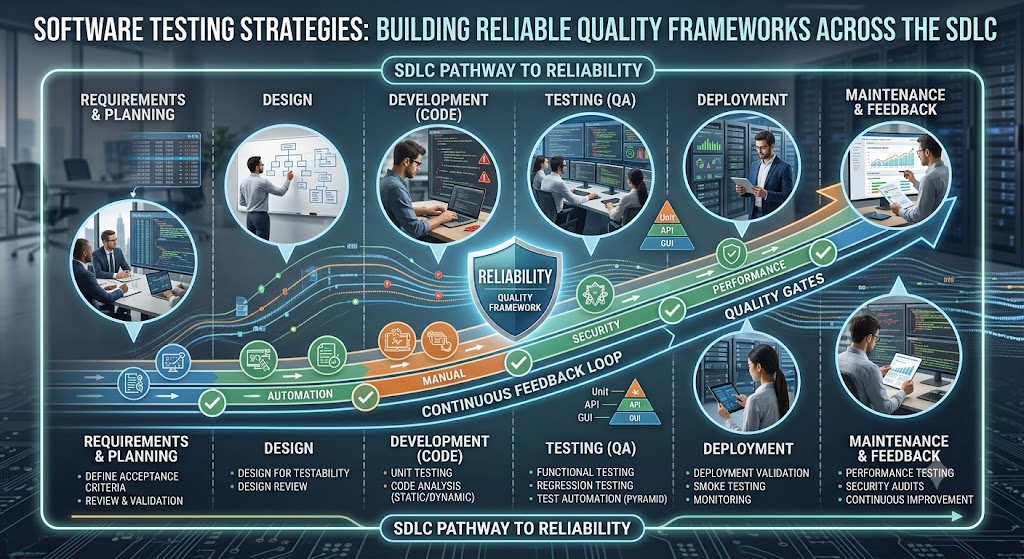
A software testing strategies is a high-level blueprint that defines the overall testing approach, objectives, tools, methodologies, and quality principles used throughout the Software Development Life Cycle (SDLC). Unlike a test plan, which focuses on specific release activities, schedules, and responsibilities, a strategy establishes the wider philosophy behind quality assurance and explains how testing decisions should support business risk management.
Modern software development has moved beyond traditional end-stage testing. Organisations now integrate quality practices into every phase of delivery, from requirements analysis and coding to deployment and monitoring. This shift has been driven by agile development, DevOps adoption, cloud infrastructure, and increasing customer expectations for reliable digital experiences.
A strong testing framework helps teams answer critical questions: Which risks matter most? What should be automated? Where should human judgement remain essential? How can testing provide confidence without slowing innovation?
Research from industry organisations such as the International Software Testing Qualifications Board highlights that structured testing practices improve defect detection and support more predictable software outcomes.
The challenge is that no single approach works for every organisation. A financial platform handling millions of transactions requires different controls from a small mobile application. Effective strategies must consider system complexity, regulatory requirements, customer expectations, security exposure, and available engineering resources.
This article examines the foundations of software testing strategies, their practical applications, risks, emerging trends, and how organisations can prepare their quality processes for the future.
Understanding the Role of Software Testing Strategies
Software testing strategies act as a quality roadmap. They define how testing contributes to software reliability rather than simply listing activities that testers must complete before release.
A well-designed strategy typically covers:
- Testing objectives
- Quality standards
- Testing levels
- Automation approach
- Risk assessment methods
- Required tools
- Team responsibilities
- Reporting and measurement frameworks
The distinction between a strategy and a test plan is important.
| Area | Software Testing Strategy | Test Plan |
| Purpose | Defines overall testing philosophy | Defines specific testing activities |
| Scope | Covers long-term SDLC approach | Covers a release or project |
| Focus | Quality principles and risk management | Tasks, deadlines, resources |
| Ownership | Usually created by QA leadership and engineering management | Usually managed by project testing teams |
| Lifespan | Remains relevant across multiple projects | Changes with each release |
A testing strategy creates consistency. Without one, teams often rely on individual preferences, resulting in inconsistent coverage and unpredictable quality outcomes.
Why Testing Strategy Matters in Modern Software Development
Software failures can create significant consequences. Bugs may lead to financial losses, security incidents, customer dissatisfaction, or operational disruption.
A testing strategy helps organisations move from reactive defect fixing to proactive risk prevention.
For example, a banking application cannot treat all defects equally. A spelling error on a help page has a different impact from an incorrect transaction calculation. A mature strategy prioritises testing based on business consequences.
Key strategic benefits include:
Improved Risk Management
Risk-based testing allows teams to concentrate effort where failure would be most damaging.
Typical high-risk areas include:
- Payment processing
- Authentication systems
- Data storage
- Customer-facing workflows
- Regulatory reporting functions
This approach prevents teams from wasting resources testing low-impact features while overlooking critical systems.
Better Development Efficiency
Testing is often incorrectly viewed as a final verification stage. Modern strategies introduce testing earlier through practices such as:
- Shift-left testing
- Automated unit testing
- Continuous integration testing
- Security testing during development
Early defect discovery usually costs less than fixing problems after deployment.
Stronger Business Alignment
A testing strategy connects engineering quality with organisational goals.
For example:
- A healthcare platform prioritises data protection and compliance.
- An online retailer prioritises transaction reliability and performance.
- A gaming platform prioritises user experience and scalability.
The strategy ensures testing reflects actual business priorities.
Core Types of Software Testing Strategies
Different organisations combine multiple approaches depending on their technical environment and risk profile.
Risk-Based Testing Strategy
Risk-based testing prioritises test activities according to probability and impact.
Teams evaluate:
- Likelihood of failure
- Customer impact
- Financial consequences
- Security implications
- Technical complexity
This approach is particularly valuable when deadlines are limited and complete testing is impossible.
Agile Testing Strategy
Agile testing integrates quality activities into short development cycles.
Instead of waiting for a finished product, testers collaborate continuously with developers, product owners, and designers.
Common practices include:
- Sprint testing
- User story validation
- Continuous feedback
- Automated regression testing
Agile strategies support faster releases but require strong communication between teams.
Automation Testing Strategy
Automation reduces repetitive manual work and improves testing speed.
Common automated areas include:
- Regression testing
- API testing
- Performance testing
- Cross-browser testing
However, automation is not a replacement for human expertise. Poorly designed automation can create maintenance costs and false confidence.
A useful principle is that organisations should automate tests that are repetitive, stable, and valuable rather than attempting to automate everything.
Continuous Testing Strategy
Continuous testing integrates quality checks into CI/CD pipelines.
The approach enables teams to evaluate software automatically throughout development.
Typical pipeline stages include:
- Code validation
- Unit testing
- Integration testing
- Security scanning
- Deployment verification
This supports faster delivery while maintaining quality controls.
The Relationship Between Testing Strategy and DevOps
DevOps has changed how organisations think about software quality. Traditional models separated development, testing, and operations. Modern approaches encourage shared responsibility.
A DevOps-focused testing strategy usually includes:
| DevOps Practice | Testing Contribution |
| Continuous Integration | Automated validation of code changes |
| Continuous Delivery | Confidence before deployment |
| Infrastructure as Code | Automated environment testing |
| Monitoring | Detection of production issues |
| Feedback loops | Faster quality improvements |
The goal is not simply faster releases. The goal is reliable releases.
Companies adopting DevOps often measure success through indicators such as deployment frequency, failure rates, recovery speed, and defect trends.
Security and Compliance Considerations in Testing Strategies
Security has become a core element of software quality.
A modern strategy should include security testing throughout the SDLC rather than treating it as a final review.
Important security testing practices include:
- Vulnerability scanning
- Penetration testing
- Code analysis
- Authentication testing
- Data protection validation
For UK organisations, compliance considerations may include requirements under the Information Commissioner’s Office and the UK General Data Protection Regulation (UK GDPR).
A weakness in testing security controls can expose organisations to financial penalties, reputational damage, and customer distrust.
Practical Comparison of Testing Approaches
| Strategy Type | Strengths | Limitations | Best Used For |
| Manual Testing | Human judgement and exploratory discovery | Slower and harder to scale | User experience evaluation |
| Automation Testing | Speed and repeatability | Requires maintenance investment | Regression and repetitive tests |
| Risk-Based Testing | Focuses resources effectively | Requires accurate risk assessment | Complex systems |
| Agile Testing | Supports rapid development | Requires team collaboration | Agile environments |
| Continuous Testing | Enables fast feedback | Requires technical maturity | DevOps pipelines |
Hidden Challenges and Trade-Offs in Testing Strategies
A sophisticated strategy does not eliminate all challenges.
Over-Automation Risk
One common mistake is assuming more automated tests always create better quality.
Automation can fail when:
- Requirements change frequently
- Tests are poorly designed
- Maintenance costs exceed benefits
A balanced strategy combines automation with exploratory testing and expert review.
Testing Environment Differences
A software application may behave differently across development, testing, and production environments.
Common causes include:
- Different databases
- Configuration differences
- Infrastructure variations
- Third-party integrations
Environment consistency is therefore a strategic concern.
Measuring the Wrong Metrics
Counting the number of tests created does not necessarily indicate quality.
More valuable measurements include:
| Metric | Purpose |
| Defect escape rate | Measures production issues |
| Test coverage | Shows tested areas |
| Mean time to recovery | Evaluates resilience |
| Automation reliability | Measures test effectiveness |
| Customer-reported defects | Reflects real-world quality |
Original Insights: Where Testing Strategies Often Fail
Quality Ownership Is Often Misaligned
Many organisations assign testing responsibility mainly to QA teams. However, quality problems frequently originate from requirements, architecture, or development decisions.
The strongest organisations treat quality as an engineering-wide responsibility.
Automation Debt Can Become Similar to Technical Debt
Automated tests require maintenance. Outdated tests create misleading results and slow development.
A practical strategy includes regular test reviews, just as software code receives maintenance.
Business Risk Should Influence Testing Investment
A small defect in a low-use feature may require less attention than a minor issue affecting thousands of customers.
Testing investment should follow business impact rather than technical convenience.
The Future of Software Testing Strategies in 2027
By 2027, software testing strategies are expected to become increasingly connected with artificial intelligence, predictive analytics, and autonomous quality monitoring.
Several trends are shaping this direction:
AI-Assisted Testing
AI tools are increasingly being used to:
- Generate test cases
- Analyse defects
- Predict risky code changes
- Improve test coverage
However, human oversight remains essential because AI-generated tests can miss business context.
Greater Security Integration
Security testing will continue moving earlier into development processes due to increasing cyber threats and regulatory expectations.
Autonomous Quality Monitoring
Production monitoring and observability platforms will increasingly contribute to testing strategies by identifying real user behaviour patterns and system weaknesses.
The future approach is unlikely to remove human testers. Instead, it will shift human roles towards analysis, risk assessment, and complex decision-making.
Key Takeaways
- A testing strategy provides the foundation for consistent software quality management.
- Risk-based approaches help organisations focus resources where failures matter most.
- Automation improves efficiency but requires careful planning and maintenance.
- Security and compliance must be integrated throughout the development lifecycle.
- Quality responsibility should extend beyond dedicated testing teams.
- Future strategies will combine human expertise with AI-supported analysis.
Conclusion
Software testing strategies provide organisations with a structured way to manage quality, reduce uncertainty, and deliver dependable digital products. They move testing beyond simple defect detection by creating a framework where technical decisions connect directly with business risk.
The most effective approaches combine multiple methods, including automation, risk-based analysis, security validation, and continuous feedback. However, successful implementation depends on realistic expectations, skilled teams, and strong collaboration between development and business stakeholders.
As software systems become more complex, testing strategies will continue evolving. The organisations that succeed will not necessarily be those with the largest number of tests, but those that understand where quality matters most and build testing practices around real-world impact.
Structured FAQ
What is a software testing strategy?
A software testing strategy is a high-level framework that defines testing objectives, methods, tools, and quality standards across the SDLC.
How is a testing strategy different from a test plan?
A strategy defines the overall testing approach, while a test plan describes specific activities, schedules, and responsibilities for a particular release.
Why is risk-based testing important?
Risk-based testing helps teams prioritise testing efforts according to the potential impact and likelihood of software failures.
Should all software tests be automated?
No. Automation is valuable for repetitive and stable tasks, but human testing remains important for exploration, usability, and complex judgement.
How does DevOps affect testing strategies?
DevOps integrates testing into continuous development and deployment workflows, allowing teams to detect problems earlier.
What role will AI play in testing by 2027?
AI will support areas such as test generation, defect analysis, and predictive quality monitoring, but human oversight will remain necessary.
Methodology
This article was developed using established software engineering principles, recognised testing frameworks, and publicly available industry guidance. Information was validated against software testing standards, DevOps research, and security best practices.
Sources considered include recognised testing bodies, software engineering publications, and industry documentation. The analysis focuses on practical implementation rather than promoting a single testing methodology.
Limitations include differences between organisations, industries, technology stacks, and regulatory requirements. Testing strategies should always be adapted to specific business risks and technical environments.
This article was drafted with AI assistance and reviewed and verified by the editorial team at RubbleMagazine.co.uk. All data, citations, and claims should be independently confirmed before publication.
References (APA Style)
International Software Testing Qualifications Board. (2023). Certified Tester Foundation Level syllabus. ISTQB.
Google Cloud. (2024). DevOps capabilities and software delivery performance research. Google Cloud.
Microsoft. (2024). DevOps documentation: Continuous integration and continuous delivery practices. Microsoft Learn.
National Institute of Standards and Technology. (2022). Secure software development framework (SSDF) version 1.1. NIST.
OWASP Foundation. (2023). OWASP software assurance maturity model and security testing guidance. OWASP.
Atlassian. (2024). Continuous integration and delivery practices for software teams. Atlassian.