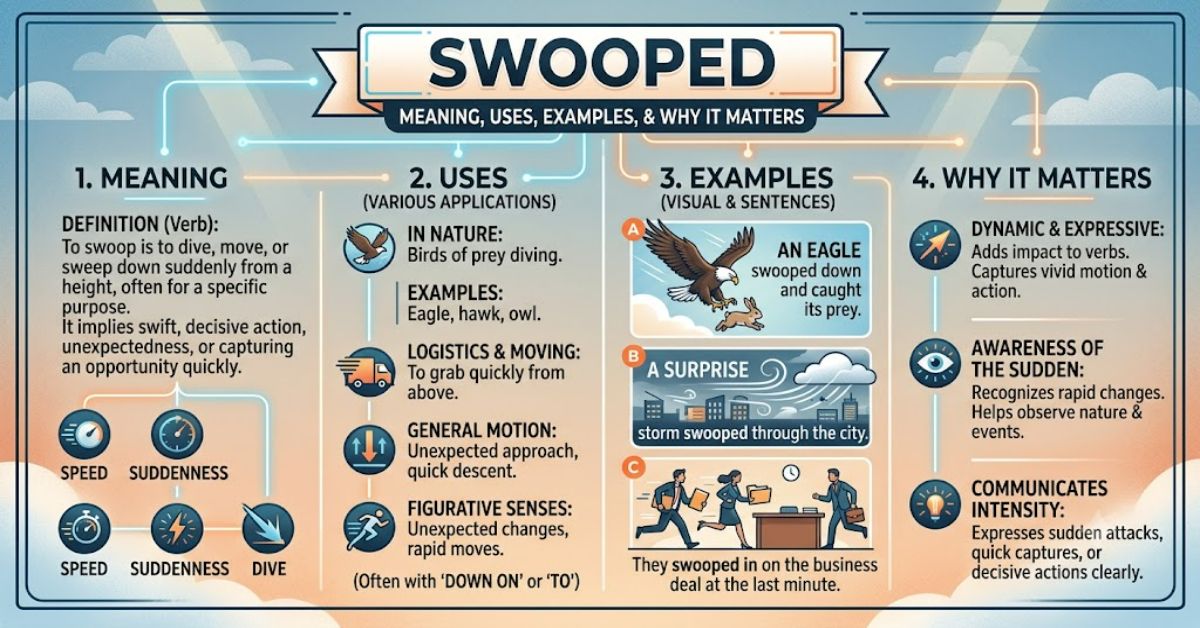
The word swooped is the past tense of the verb swoop, a term that commonly describes a fast, smooth movement downward through the air. Birds of prey provide the classic example—a hawk may swoop down to catch its prey. However, modern English uses the word in many more situations than aviation or wildlife. Journalists write that police “swooped” on suspects, businesses “swooped” to acquire competitors, and sports commentators say a striker “swooped” on a loose ball to score.
Because the word conveys speed, precision, and sudden action, it has become a favourite in storytelling and news reporting. Understanding its different meanings helps readers interpret headlines correctly and use the term naturally in writing and conversation.
What Does “Swooped” Mean?
At its core, swooped describes a rapid movement from a higher position to a lower one.
Common dictionary meanings include:
- Moving quickly through the air.
- Descending suddenly to seize or attack.
- Acting rapidly to take advantage of an opportunity.
- Arriving unexpectedly and decisively.
Although the original meaning relates to flight, modern English often uses the word metaphorically.
Literal and Figurative Uses
Literal Meaning
In nature, birds such as hawks, falcons, and eagles frequently swoop toward prey before capturing it.
Example:
- The eagle swooped over the river and caught a fish.
Figurative Meaning
Outside nature, the word often represents quick, decisive action.
Examples include:
- Police swooped on an organised crime group.
- Investors swooped to buy undervalued shares.
- A footballer swooped in to score the winning goal.
- Shoppers swooped on seasonal discounts.
Common Contexts
| Context | Example |
| Wildlife | A hawk swooped on its prey. |
| News | Officers swooped during the investigation. |
| Business | A company swooped to acquire a competitor. |
| Sport | The striker swooped on a rebound. |
| Everyday Speech | She swooped in to help her friend. |
The underlying idea remains the same: fast, purposeful action.
Why Writers Frequently Use the Word
Journalists and authors favour words that create vivid mental images. “Swooped” immediately suggests urgency and movement without requiring lengthy explanations.
For example:
- “Police arrested three suspects” is factual.
- “Police swooped on three suspects” creates a stronger sense of timing and coordination.
This makes the word especially common in newspapers, novels, sports reporting, and television commentary.
Language Insights
| Feature | Explanation |
| Part of Speech | Verb (past tense) |
| Base Form | Swoop |
| Present Participle | Swooping |
| Common Tone | Dynamic, dramatic |
| Typical Context | Action, speed, surprise |
One interesting aspect of the word is that it often carries a slightly dramatic tone. While appropriate for journalism and storytelling, it may be unnecessary in formal academic writing unless describing literal movement.
Another observation is that readers generally associate the word with positive efficiency or decisive intervention, although the outcome may be good or bad depending on context.
Finally, the word remains popular because it communicates an entire sequence of action with a single verb.
Risks of Overusing Dramatic Language
Although “swooped” is effective, writers should avoid using it excessively.
Potential drawbacks include:
- Making routine events appear more dramatic than they are.
- Reducing credibility in factual reporting.
- Creating repetitive writing if similar action verbs appear too frequently.
Good writing balances vivid verbs with precise descriptions.
The Future of Language Use in 2027
Language continues evolving alongside digital communication. Short, expressive verbs like swooped are likely to remain common because they quickly capture attention in headlines and social media posts.
Artificial intelligence, automated journalism, and digital publishing may encourage clearer writing, but concise action verbs will still play an important role in engaging readers. As communication becomes increasingly mobile-first, words that create immediate visual imagery are expected to remain valuable.
Key Takeaways
- “Swooped” means moving or acting quickly and decisively.
- The word is used literally and metaphorically.
- News organisations frequently use it in headlines.
- It adds energy and movement to writing.
- Writers should avoid unnecessary overuse.
- Context determines the exact meaning.
Conclusion
The word swooped is much more versatile than many people realise. While its original meaning describes rapid movement through the air, modern English applies it across journalism, business, sport, and everyday conversation. Its popularity comes from its ability to communicate speed, surprise, and decisive action in just one word.
Whether describing an eagle hunting, police conducting an operation, or a company making a timely acquisition, the word helps create vivid mental imagery for readers. Used thoughtfully, it strengthens writing without becoming overly dramatic. Understanding its multiple meanings allows both readers and writers to appreciate why this simple verb continues to appear so frequently in modern English.
Frequently Asked Questions
What does “swooped” mean?
It is the past tense of swoop and generally means moving quickly downward or acting suddenly to seize an opportunity.
Is “swooped” only used for birds?
No. It is commonly used figuratively in news, business, sports, and everyday conversation.
Why do journalists use the word so often?
Because it creates a vivid image of rapid, decisive action while keeping headlines concise.
Can “swooped” have a positive meaning?
Yes. It may describe someone arriving quickly to help, rescue, or take advantage of an opportunity.
Is “swooped” suitable for formal writing?
Yes, when used accurately. However, in highly academic or technical writing, a more neutral verb may sometimes be preferable.
Methodology
This article was prepared using standard English dictionaries, educational language resources, and examples from contemporary journalism. Meanings were compared across multiple authoritative sources to ensure balanced and accurate explanations. Since language evolves over time, readers should also consider contextual usage when interpreting the word.
References
- Cambridge Dictionary. (2024). Swoop. https://dictionary.cambridge.org/
- Oxford English Dictionary. (2024). Swoop.
- Merriam-Webster. (2024). Swoop. https://www.merriam-webster.com/