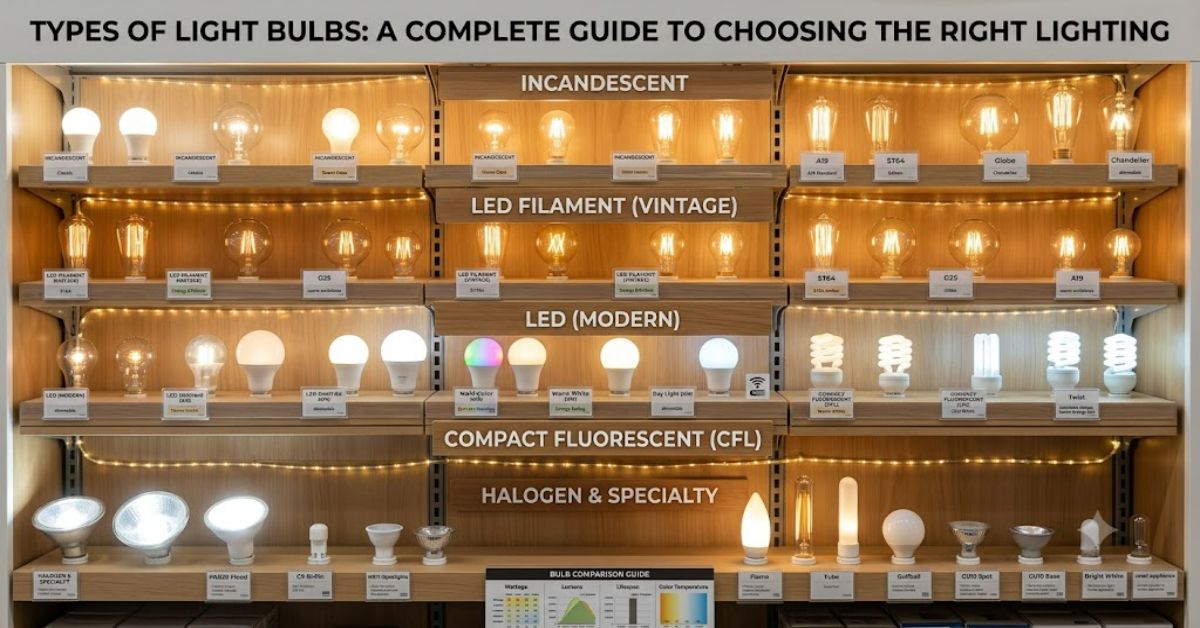
Lighting technology has changed significantly over the last few decades. Understanding the different types of light bulbs helps homeowners make better decisions about energy use, brightness and atmosphere.
The main options available today are LED, halogen, CFL and incandescent bulbs. Each technology works differently, offering different levels of efficiency, lifespan and performance. While traditional incandescent bulbs were once common, modern households increasingly choose LED alternatives because they provide longer service life and lower electricity consumption.
When selecting a bulb, consumers should focus on lumens instead of watts. Watts measure energy consumption, while lumens measure actual brightness. Colour temperature, measured in Kelvins (K), also influences how a room feels, ranging from warm yellow lighting to cooler white tones.
With energy costs remaining a major household concern in the UK, choosing efficient lighting has become an important part of reducing unnecessary electricity use.
Comparing the Main Light Bulb Technologies
The four traditional categories represent different stages of lighting development.
| Bulb Type | Energy Efficiency | Average Lifespan | Common Uses |
| LED | Excellent | 15,000–50,000 hours | Homes, offices, outdoor lighting |
| Halogen | Moderate | Around 2,000 hours | Spotlights and decorative fixtures |
| CFL | Good | Around 8,000 hours | Older energy-saving installations |
| Incandescent | Low | Around 1,000 hours | Traditional decorative lighting |
LED Bulbs: The Modern Standard
LED bulbs have become the dominant lighting choice because they convert electricity into light far more efficiently than older technologies.
Unlike incandescent bulbs, which create light by heating a filament, LEDs use semiconductor technology. This process produces significantly less wasted heat.
A typical LED bulb can use around 80–90% less energy than an equivalent incandescent bulb while lasting many times longer. This makes LEDs particularly attractive for frequently used areas such as kitchens, living rooms and hallways.
Another advantage is flexibility. Modern LED products are available in different brightness levels, colours and smart-home formats. Some models can connect with automated systems, allowing users to adjust brightness and colour through mobile applications.
Halogen Bulbs: Improved but Limited
Halogen bulbs are a more efficient version of incandescent lighting. They use a tungsten filament surrounded by halogen gas, allowing the filament to operate at a higher temperature.
Their advantages include:
- Instant full brightness
- Good colour accuracy
- Compact designs
However, halogen technology still produces considerable heat and consumes more electricity than LEDs. In the UK, many halogen lamps have been phased out of sale under energy efficiency regulations as governments encourage lower-energy alternatives.
CFL Bulbs: The Transitional Technology
Compact fluorescent lamps (CFLs) were widely promoted as energy-saving replacements for incandescent bulbs during the early 2000s.
They use gas discharge technology to create light and require less electricity than traditional bulbs. However, CFL adoption declined because of several limitations:
- Slower warm-up times
- Larger physical size
- Mercury content requiring careful disposal
Although CFL bulbs remain usable, many consumers have moved towards LEDs because they provide better performance without these drawbacks.
Incandescent Bulbs: Traditional but Inefficient
Incandescent bulbs represent the oldest common lighting technology. They produce light by heating a wire filament until it glows.
Their advantages are simplicity and warm appearance, but most energy is released as heat rather than visible light.
Because of poor efficiency, incandescent bulbs have become less common in many countries. Their decline demonstrates how energy standards and consumer preferences influence product markets.
Understanding Lumens and Kelvin Ratings
One common mistake when buying lighting is focusing only on wattage.
| Measurement | Meaning | Example |
| Lumens | Brightness output | 800 lumens approximates a traditional 60W bulb |
| Watts | Energy consumption | Lower wattage usually means lower electricity use |
| Kelvin | Colour temperature | 2700K creates warm lighting, 5000K creates cooler light |
A bedroom may benefit from warmer lighting around 2700K–3000K, while kitchens, garages and workspaces often suit cooler temperatures.
Practical Considerations Before Buying
Choosing a bulb involves more than selecting the brightest option.
Check the Fixture Compatibility
Some fittings have restrictions on bulb shape, size or heat output. Enclosed fixtures, for example, may require LEDs specifically designed for limited airflow.
Consider Usage Patterns
The best choice depends on how often a light is used. A hallway light switched on frequently benefits greatly from a long-lasting LED bulb.
Balance Cost and Performance
Although LED bulbs often cost more upfront, their lower energy consumption and longer lifespan usually reduce total ownership costs.
The Future of Lighting in 2027
By 2027, LED technology is expected to remain the dominant household lighting solution. Growth is likely to come from connected lighting systems, improved efficiency and integration with smart-home technology.
Regulations from bodies such as the UK government’s Department for Energy Security and Net Zero continue to encourage energy-saving products and reduced household emissions.
However, challenges remain. Electronic components inside smart bulbs create recycling concerns, and consumers may face compatibility issues as lighting becomes increasingly software-based.
The future of lighting will likely focus on efficiency, automation and improved user control rather than entirely new bulb technologies.
Key Takeaways
- LED technology currently provides the strongest combination of efficiency and lifespan.
- Lumens are more useful than watts when comparing brightness.
- Kelvin ratings help create the correct atmosphere for different rooms.
- Halogen and incandescent bulbs are becoming less practical due to energy consumption.
- Smart lighting is expanding but introduces additional technology considerations.
- Proper bulb selection can reduce household energy costs.
Conclusion
Choosing between different types of light bulbs requires understanding how each technology performs. While incandescent and halogen bulbs remain familiar, LED lighting has become the clear choice for most modern homes because of its efficiency, durability and flexibility.
The most effective approach is to consider brightness, colour temperature, fixture requirements and long-term costs rather than simply buying the cheapest option available.
As lighting technology continues developing, energy efficiency and smart controls will shape future products. For households looking to reduce electricity use while maintaining comfortable lighting, selecting the right bulb remains a simple but valuable improvement.
Frequently Asked Questions
What are the main types of light bulbs?
The main types are LED, halogen, CFL and incandescent bulbs. LED products are now the most widely recommended because they use less energy and last longer.
Which type of light bulb is most energy efficient?
LED bulbs are the most energy-efficient option currently available for general household lighting.
Should I choose bulbs based on watts or lumens?
You should compare lumens because they indicate brightness. Watts only show how much electrical power the bulb consumes.
What does Kelvin mean on a light bulb?
Kelvin measures colour temperature. Lower numbers create warmer yellow light, while higher numbers produce cooler white lighting.
Are CFL bulbs still worth buying?
CFL bulbs can still work efficiently, but LEDs usually provide better lifespan, instant brightness and easier disposal.
How long do LED bulbs last?
Many LED bulbs last between 15,000 and 50,000 hours depending on quality, usage and operating conditions.
Methodology
This article Types of Light Bulbs was created using established lighting principles, energy efficiency guidance and publicly available information from recognised energy organisations.
Sources were reviewed for technical accuracy, including information from the UK government, Energy Saving Trust and lighting industry guidance.
Limitations include differences between individual bulb manufacturers, product specifications and future regulatory changes.
This article was drafted with AI assistance and requires editorial verification before publication. All technical claims, statistics and references should be checked against original sources.
References (APA Style)
Department for Energy Security and Net Zero. (2024). Energy efficiency policy and household energy guidance. UK Government.
Energy Saving Trust. (2024). Energy efficient lighting advice. Energy Saving Trust.
International Energy Agency. (2023). Energy efficiency and lighting technology overview. International Energy Agency.
LightingEurope. (2024). Lighting technology and sustainability guidance. LightingEurope.