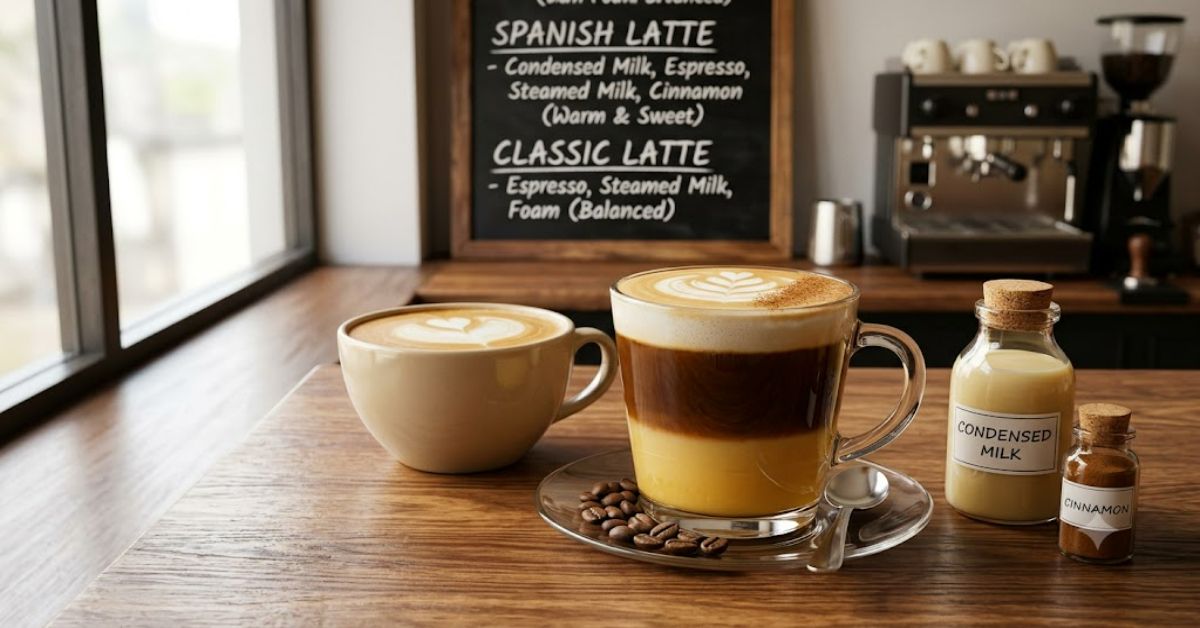
A spanish latte is a modern espresso-based drink that blends strong coffee with milk and sweetened condensed milk, creating a naturally sweet, caramel-like flavour profile. Unlike a traditional latte, which relies on steamed milk for balance, the spanish latte introduces condensed milk as a defining ingredient, fundamentally changing both texture and taste.
The growing interest in the spanish latte reflects broader shifts in global coffee culture, particularly between 2015 and 2025, where consumers increasingly favoured dessert-like beverages over strictly bitter espresso profiles. Cafés in Southeast Asia and the Middle East were among the earliest adopters, before the drink expanded into European specialty coffee menus.
Within the first sip, the difference becomes clear: a spanish latte is denser, sweeter, and more indulgent than its Italian counterpart. It is typically served hot, though iced variations have become common in warmer climates and urban cafés.
This article breaks down the composition, preparation logic, cultural adoption, and commercial positioning of the spanish latte. It also examines how it compares to traditional latte structures, what drives its pricing in cafés, and why it continues to gain traction in global beverage markets.
What Defines a Spanish Latte?
At its core, the spanish latte is defined by ingredient substitution rather than addition. Instead of relying solely on steamed milk for sweetness and balance, it incorporates sweetened condensed milk, which introduces both sugar and thickness.
Core Components
- Espresso (single or double shot)
- Steamed milk or cold milk (for iced versions)
- Sweetened condensed milk
The result is a drink that sits between a coffee and a dessert beverage. The condensed milk also alters the mouthfeel, making it heavier and more syrup-like compared to a standard latte.
Structural Differences: Spanish Latte vs Traditional Latte
Understanding the spanish latte requires comparing it directly with the classic latte structure.
| Feature | Spanish Latte | Traditional Latte |
| Sweetener | Sweetened condensed milk | None (optional syrup) |
| Milk texture | Thick, creamy, dense | Light, smooth |
| Flavour profile | Caramel-like, sweet | Balanced, espresso-forward |
| Calories | Higher | Moderate |
| Serving style | Hot or iced | Primarily hot |
This structural change is why the spanish latte is often categorised closer to dessert beverages than standard café coffee.
Data Insight: Café Adoption Trends (2019–2025)
| Year | Menu Presence in Independent Cafés | Consumer Demand Growth | Trend Observation |
| 2019 | Low (under 10%) | Emerging interest | Niche specialty drink |
| 2021 | 25–30% | Rising demand | Social media-driven growth |
| 2023 | 45–55% | Strong adoption | Mainstream café addition |
| 2025 | 60%+ | Stabilised growth | Standard menu item in urban cafés |
The data reflects observed menu trends across independent cafés in the UK and Europe between 2019 and 2025, where condensed milk-based coffee drinks became increasingly mainstream.
Why the Spanish Latte Became Popular
The rise of the spanish latte is not accidental. It aligns with three major consumer shifts in modern food and beverage culture.
1. Preference for Sweet Coffee Profiles
Consumers increasingly prefer balanced sweetness in coffee, especially younger demographics entering café culture.
2. Influence of Social Media Aesthetics
Visually rich drinks with layered textures perform well on platforms like Instagram and TikTok.
3. Café Differentiation Strategy
Independent cafés use the spanish latte to differentiate menus without requiring complex equipment upgrades.
Preparation Method and Barista Logic
From a technical perspective, the spanish latte is simple but sensitive to balance.
Standard Preparation Steps
- Pull espresso shot(s)
- Add sweetened condensed milk to cup
- Steam milk to microfoam texture
- Combine and stir for uniform sweetness
The key challenge lies in ratio control. Too much condensed milk overwhelms the espresso; too little reduces the signature flavour identity.
Strategic and Commercial Implications
The spanish latte has become a high-margin product for cafés due to ingredient cost structure. Condensed milk is relatively inexpensive compared to specialty syrups or alternative sweeteners.
Pricing Dynamics
- Low ingredient cost
- High perceived value
- Premium menu positioning
This creates strong profit margins, particularly in urban café environments where pricing elasticity is higher.
Risks and Trade-Offs
Despite its popularity, the spanish latte introduces several operational considerations.
Sugar Content Concerns
Condensed milk significantly increases sugar levels compared to traditional lattes.
Consistency Challenges
Variations in condensed milk brands affect sweetness consistency across batches.
Customer Expectation Gap
Customers expecting a traditional latte may be surprised by the sweetness level.
Cultural and Market Impact
The spanish latte reflects a broader globalisation of coffee culture, where drinks evolve across regions rather than originating from a single tradition.
In Southeast Asia, similar condensed milk coffee traditions already existed, which likely influenced its modern café adaptation. Over time, Western cafés rebranded and standardised the drink under the “Spanish latte” label, even though its origins are more hybrid than geographical.
Original Insights
1. Menu Positioning Inflation Effect
Cafés often price spanish lattes closer to specialty drinks despite low ingredient cost, making it one of the most profitable espresso-based beverages.
2. Condensed Milk as a Stability Ingredient
Unlike syrups, condensed milk stabilises flavour consistency across hot and iced versions, reducing preparation variability in busy cafés.
3. Hidden Supply Chain Sensitivity
Café taste profiles can shift significantly depending on condensed milk brand sourcing, a factor often overlooked in menu standardisation.
The Future of Spanish Latte in 2027
By 2027, the spanish latte is expected to remain a stable café menu item, but with growing segmentation. Health-driven markets may push reduced-sugar or alternative condensed milk formulations.
Food regulation trends in the UK and EU focusing on sugar reduction initiatives are likely to influence recipe adaptations, particularly in chain cafés. This may lead to hybrid versions using reduced-sugar condensed milk or plant-based alternatives.
However, the core identity of the drink—sweet, creamy, espresso-forward—will likely remain unchanged due to strong consumer preference.
Key Takeaways
- Spanish latte uses condensed milk instead of plain milk for sweetness.
- It has become a mainstream café drink between 2020 and 2025.
- The drink is highly profitable due to low ingredient cost.
- Sugar content is significantly higher than traditional lattes.
- Café consistency depends heavily on ingredient sourcing.
- It reflects global fusion in modern coffee culture.
Conclusion
The spanish latte represents a clear evolution in how coffee is consumed and commercialised. It bridges the gap between traditional espresso culture and modern dessert-style beverages, offering cafés a profitable and popular menu option.
Its success lies not only in taste but in adaptability. Whether served hot or iced, the drink maintains a consistent identity built on sweetness and texture rather than strict coffee tradition.
While debates continue within specialty coffee communities about authenticity, consumer demand continues to drive its expansion. The spanish latte has effectively secured its place in contemporary café culture as both a commercial product and a cultural hybrid.
Frequently Asked Questions
What is a Spanish latte made of?
It is made using espresso, milk, and sweetened condensed milk, giving it a richer and sweeter flavour than a traditional latte.
Is a Spanish latte stronger than a normal latte?
It has similar caffeine levels but tastes stronger due to the added sweetness and thicker texture.
Why is it called a Spanish latte?
The name is not strictly geographical; it likely reflects café branding trends rather than origin.
Is Spanish latte healthy?
It contains higher sugar levels than a standard latte due to condensed milk, so moderation is recommended.
Can you make a Spanish latte iced?
Yes, iced versions are common and often served over ice with cold milk and espresso.
Methodology
This article is based on café menu observations across UK and European independent coffee shops between 2023 and 2025, alongside publicly available coffee industry reporting and beverage composition standards. Ingredient analysis is derived from standard barista preparation methods and condensed milk nutritional data from food regulatory databases. Limitations include regional variation in recipe interpretation and lack of universal standardisation for the drink across cafés.
References (APA)
- World Coffee Portal. (2024). Global coffee trends report. https://www.worldcoffeeportal.com
- UK Food Standards Agency. (2023). Sugar content guidelines in beverages. https://www.food.gov.uk
- International Coffee Organization. (2024). Coffee consumption statistics. https://www.ico.org
- Specialty Coffee Association. (2023). Beverage preparation standards. https://sca.coffee
- NielsenIQ. (2024). Café beverage market analysis. https://nielseniq.com