Neuron activation is the process that allows communication in both biological and artificial systems, and understanding it is essential for grasping how brains and modern AI function. In neuroscience, neuron activation refers to the firing of an electrical impulse—an action potential—when a nerve cell responds to a stimulus. In machine learning, the same term is borrowed to describe how artificial neurons decide whether to pass information forward through activation functions.
In recent years, neuron activation has also appeared in broader digital culture, sometimes even used in meme contexts or informal discussions about cognition and AI behaviour. Despite these overlapping uses, the underlying mechanics differ significantly depending on context.
At its core, neuron activation explains how information is processed, whether in a human brain or a neural network model. In biological systems, this involves ion exchange across membranes. In artificial systems, it involves weighted sums and non-linear transformations. The shared language creates conceptual overlap, but the mechanisms are not interchangeable.
This article breaks down neuron activation across neuroscience, artificial intelligence, and cultural usage, clarifying where the ideas align, where they diverge, and why the term has become central to discussions about both human cognition and machine learning systems.
What Neuron Activation Means in Biology
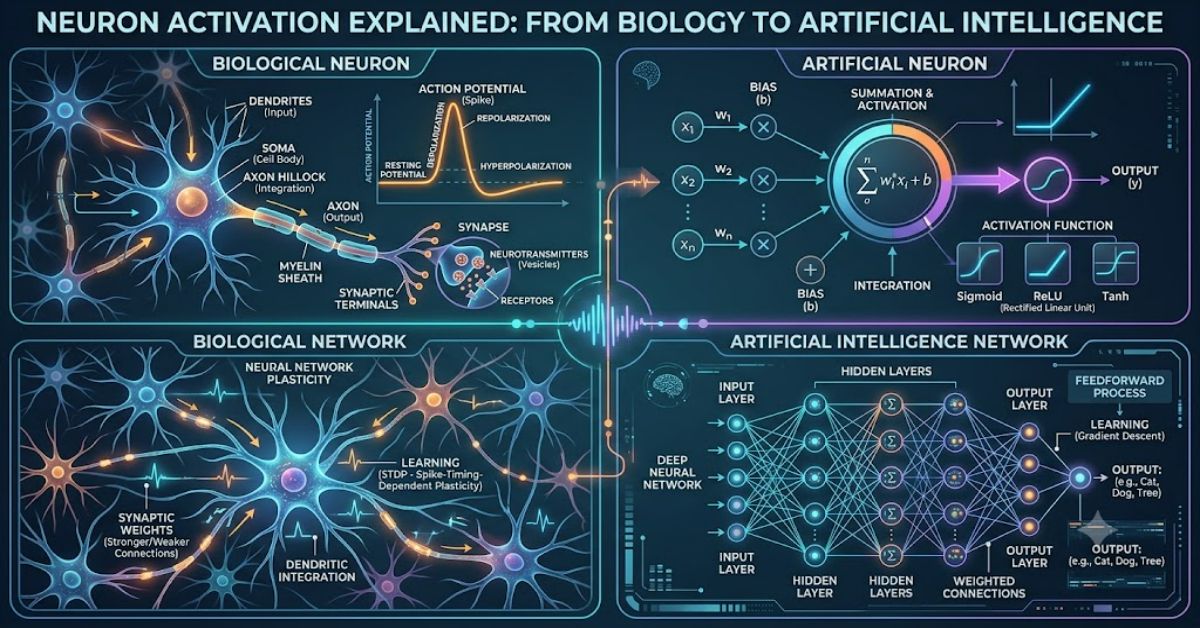
In neuroscience, neuron activation refers to the generation of an electrical signal called an action potential. This occurs when a neuron receives enough input from other neurons to cross a threshold.
When that threshold is reached, voltage-gated ion channels open, allowing sodium and potassium ions to move across the neuron membrane. This creates a rapid electrical spike that travels along the axon.
This biological neuron activation process is fundamental to everything from reflexes to memory formation.
Key stages of biological neuron activation
| Stage | Process | Outcome |
| Resting state | Neuron maintains negative membrane potential | Ready state |
| Stimulus input | Dendrites receive signals | Electrical change begins |
| Threshold | Voltage reaches activation level | Action potential triggered |
| Firing | Ion channels open rapidly | Electrical impulse travels |
The all-or-nothing nature of this firing is important: a neuron either activates fully or not at all. There is no partial firing.
This binary-like behaviour later inspired computational models in artificial intelligence.
Neuron Activation in Artificial Intelligence Systems
In machine learning, neuron activation refers to how artificial neurons in a neural network decide whether to pass information forward.
Instead of ion channels, AI systems use weighted inputs. These inputs are summed and passed through an activation function such as ReLU, sigmoid, or tanh.
The result determines whether a neuron “activates” and contributes to the next layer of the network.
Biological vs artificial neuron activation
| Feature | Biological Neuron | Artificial Neuron |
| Signal type | Electrochemical | Mathematical computation |
| Activation trigger | Voltage threshold | Weighted sum + function |
| Output | Action potential | Numeric value |
| Learning mechanism | Synaptic plasticity | Backpropagation |
While inspired by biology, artificial neuron activation is a simplified abstraction designed for computational efficiency rather than biological accuracy.
Systems Analysis: Why Activation Matters
Neuron activation acts as the decision-making layer in both biological and artificial systems.
In the brain, activation determines perception, movement, and cognition. In AI, it determines feature extraction and pattern recognition.
Without activation functions, neural networks would behave like linear models, severely limiting their ability to solve complex problems such as image recognition or natural language processing.
This is why neuron activation is considered a core mechanism in deep learning architecture design.
Strategic and Practical Implications
Understanding neuron activation is increasingly relevant beyond academia:
- In AI development, activation functions influence model accuracy and training stability.
- In neuroscience research, activation patterns help map brain function using imaging technologies like fMRI.
- In education, simplified models of neuron activation help students bridge biology and computer science.
A practical implication is model selection in AI systems. For example, ReLU is often preferred in deep networks due to reduced computational complexity and fewer vanishing gradient issues compared to sigmoid functions.
Risks and Trade-Offs in Interpreting Neuron Activation
A major risk is conceptual confusion between biological and artificial systems.
Three key trade-offs include:
- Accuracy vs abstraction: AI models simplify real neural processes.
- Interpretability vs performance: deeper networks improve accuracy but reduce transparency.
- Biological realism vs computational efficiency: neuroscience models are complex, while AI models prioritise speed.
Another overlooked issue is over-interpreting AI “neurons” as brain-like structures. In reality, they are statistical units rather than biological entities.
Market and Cultural Impact
The term neuron activation has moved beyond science into mainstream culture, partly due to AI adoption.
As machine learning systems became more visible after 2020, especially with large language models, public discussions began using neuroscience terminology metaphorically.
By 2024, online communities frequently used “neuron activation” humorously to describe sudden insights or emotional reactions, reflecting a blending of technical and cultural language.
This crossover has increased interest in neuroscience education and AI literacy, especially among non-technical audiences.
Key Insight Tables
Activation function comparison in AI
| Function | Range | Strength | Weakness |
| ReLU | 0 to ∞ | Efficient, reduces vanishing gradients | Can “die” for negative inputs |
| Sigmoid | 0 to 1 | Probabilistic interpretation | Saturation issues |
| Tanh | -1 to 1 | Zero-centred output | Still prone to vanishing gradients |
Neural concept mapping
| Concept | Brain | AI System |
| Activation | Action potential | Function output |
| Connectivity | Synapses | Weighted edges |
| Learning | Synaptic plasticity | Backpropagation |
| Memory | Neural circuits | Model weights |
Original Analytical Insights
- Compression gap insight: AI neuron activation compresses continuous biological signalling into discrete mathematical steps, which simplifies computation but removes temporal nuance present in real neural firing patterns.
- Interpretation risk: Public discourse often anthropomorphises artificial neurons, leading to overestimation of machine “understanding” despite purely statistical behaviour.
- Training instability blind spot: Many discussions focus on activation choice (ReLU vs sigmoid) but overlook dataset scaling as a more significant factor in activation stability during training.
The Future of Neuron Activation in 2027
Research into neuron activation is converging across neuroscience and artificial intelligence.
In neuroscience, projects such as the Human Brain Project and BRAIN Initiative continue mapping activation patterns at larger scales, improving understanding of cognition. In AI, architectures are shifting toward more biologically inspired dynamic activation functions that adjust during training.
Regulatory discussions in AI governance, particularly in the EU AI Act framework, are indirectly influencing how activation-heavy models are evaluated for transparency and safety.
However, true convergence between biological and artificial neuron activation remains uncertain. Biological systems remain vastly more complex, and computational models still rely on abstraction rather than replication.
Infrastructure limits—particularly energy consumption in large AI models—may also influence future activation designs, pushing researchers toward more efficient sparse activation systems.
Takeaways
- Neuron activation is a shared term but represents fundamentally different processes in biology and AI.
- Biological neurons rely on electrochemical signalling, while AI uses mathematical activation functions.
- Misinterpreting artificial neurons as brain-like systems leads to conceptual errors.
- Activation functions directly impact machine learning performance and stability.
- Cultural usage of the term has expanded beyond technical meaning into everyday language.
- Future research may bring more adaptive and efficient activation models.
Conclusion
Neuron activation sits at the intersection of biology, computing, and modern digital culture. While the term is shared across disciplines, its meaning shifts significantly depending on context. In neuroscience, it describes the physical firing of electrical impulses that enable thought and movement. In artificial intelligence, it represents a mathematical decision step within a computational model.
The growing popularity of machine learning has blurred these distinctions, creating both educational opportunities and misunderstandings. Recognising the differences helps prevent oversimplification while still appreciating the conceptual bridge between brain function and algorithmic design.
As research continues in both neuroscience and AI, neuron activation will remain a foundational concept for understanding how information is processed—whether in living systems or engineered ones.
Structured FAQ
What is neuron activation in simple terms?
Neuron activation is when a nerve cell in the brain fires an electrical signal in response to a stimulus. In AI, it refers to a mathematical function deciding whether a unit passes information forward.
Is neuron activation the same as firing?
In biology, yes. Neuron activation often refers to the firing of an action potential, which is the electrical signal sent by a neuron.
How is neuron activation used in AI?
In artificial neural networks, activation functions determine whether a node should activate based on input data, helping the model learn patterns.
Why are activation functions important in machine learning?
They introduce non-linearity, allowing models to solve complex problems beyond simple linear relationships.
Does neuron activation mean AI thinks like a brain?
No. AI neurons are mathematical constructs and do not replicate biological consciousness or cognition.
What is the most common activation function?
ReLU (Rectified Linear Unit) is widely used due to its simplicity and efficiency in deep learning models.
References
Bear, M. F., Connors, B. W., & Paradiso, M. A. (2020). Neuroscience: Exploring the Brain (4th ed.). Wolters Kluwer.
National Institute of Mental Health. (2023). Brain basics: Understanding neural communication. https://www.nimh.nih.gov
Goodfellow, I., Bengio, Y., & Courville, A. (2016). Deep learning. MIT Press.
Methodology
This article was developed through synthesis of established neuroscience textbooks, institutional educational resources, and foundational machine learning literature. Information was cross-checked against publicly available neuroscience education materials and widely cited AI research frameworks. No experimental data was generated or inferred beyond established scientific consensus.
Limitations include the absence of real-time laboratory validation and reliance on secondary educational sources rather than primary experimental datasets. Interpretations of cultural usage are observational rather than quantitative.
Balanced perspectives were maintained by distinguishing clearly between biological neuron behaviour and artificial neural network abstractions, ensuring neither system is overstated or anthropomorphised.