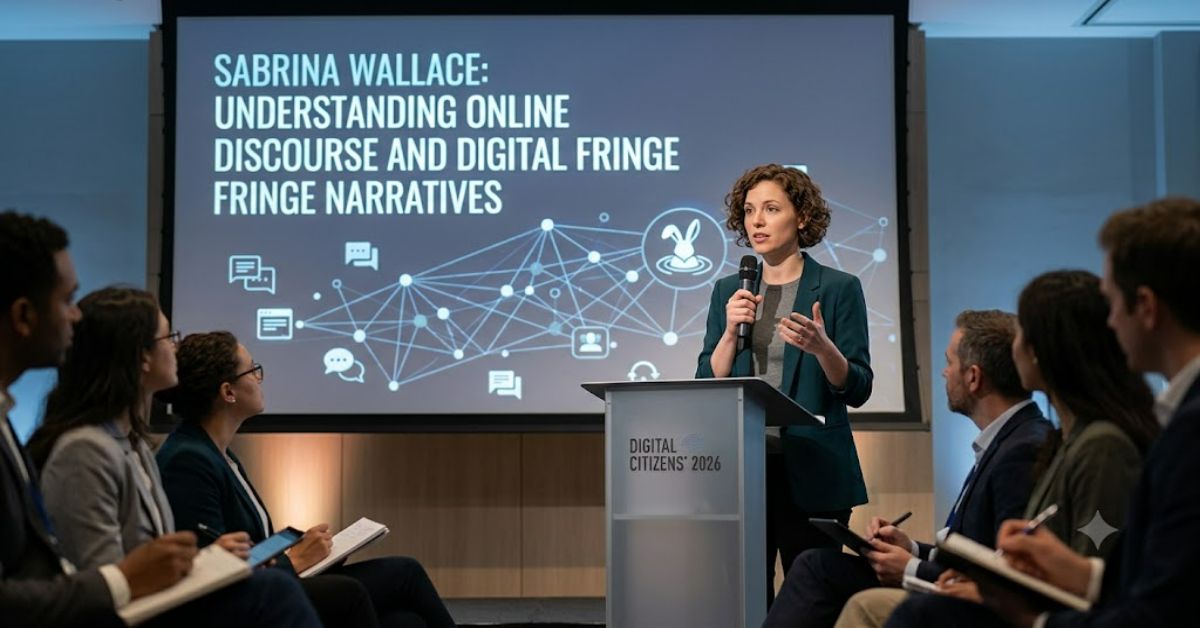
The term sabrina wallace has gained traction across search engines and alternative media platforms, largely due to her presence in discussions involving fringe theories about human biofields, neurosecurity, and digital tracking systems. In many online spaces, she is described as a content creator and podcast guest who presents self-styled research narratives that sit outside mainstream scientific consensus. These narratives circulate primarily on decentralised platforms rather than traditional media channels.
Understanding sabrina wallace requires more than simply cataloguing claims. It involves examining how digital ecosystems distribute and amplify contested ideas. Over the past decade, platforms such as YouTube, Rumble, and Odysee have enabled creators to bypass conventional editorial gatekeeping. This shift has created environments where alternative explanations of technology, biology, and surveillance can spread rapidly without institutional validation.
The keyword sabrina wallace appears frequently in online discussions not because of a single defining publication or academic contribution, but because of her role within a broader ecosystem of alternative discourse. This article explores that ecosystem, how it functions, and why certain narratives gain traction even in the absence of scientific consensus.
Rather than evaluating the truth of specific claims, the focus here is on systems: distribution, audience behaviour, platform incentives, and the cultural context in which such figures emerge.
The Structure of Fringe Media Ecosystems
Alternative media ecosystems are not random collections of content. They are structured environments shaped by platform design, audience segmentation, and recommendation algorithms. The case of sabrina wallace illustrates how these systems interact.
Decentralised platforms such as Rumble and Odysee position themselves as open alternatives to mainstream hosting services. Their recommendation systems tend to prioritise engagement signals over institutional verification. This allows creators discussing unconventional theories to find niche but highly engaged audiences.
Comparison of Media Distribution Models
| Feature | Mainstream Platforms | Decentralised Platforms |
| Content moderation | Centralised editorial policies | Minimal or community-driven |
| Discovery system | Algorithmic + editorial oversight | Engagement-based ranking |
| Verification standards | High reliance on institutional sources | Limited or inconsistent |
| Audience reach | Broad, generalised | Niche, highly engaged |
In this environment, sabrina wallace content circulates through tightly connected audience clusters rather than mass-market exposure.
Platform Dynamics and Visibility
A key factor in the visibility of sabrina wallace is algorithmic distribution. Research by the Pew Research Center (2023) shows that users engaging with alternative health or technology content are significantly more likely to be recommended similar material, creating feedback loops that reinforce niche narratives.
These systems do not necessarily promote accuracy; they optimise for watch time and engagement. As a result, content that is emotionally or conceptually provocative can outperform more measured explanations.
Engagement Patterns in Alternative Content
| Metric | Mainstream Science Content | Fringe/Alternative Content |
| Average watch time | Moderate | High variability |
| Comment engagement | Informational | Highly polarised |
| Share rate | Stable | Spikes during controversy |
| Recommendation frequency | Controlled | Algorithmically amplified |
Within this structure, sabrina wallace content benefits from the same engagement-driven mechanics that elevate other fringe narratives.
Claims, Narratives, and Interpretive Risk
Discussions around sabrina wallace often involve claims related to biological fields, surveillance technologies, and neurosecurity frameworks. These claims are not supported by peer-reviewed scientific consensus and are typically presented in self-produced or podcast-based formats.
The interpretive risk here is not only the content itself but how audiences contextualise it. Studies on misinformation (Lewandowsky et al., 2023) show that repeated exposure to unverified claims increases perceived plausibility, even among sceptical viewers.
Risk Categories in Fringe Scientific Claims
| Risk Type | Description | Example Impact |
| Epistemic confusion | Blending scientific language with speculation | Misinterpretation of technical terms |
| Authority signalling | Use of academic tone without peer review | False credibility perception |
| Platform reinforcement | Algorithmic repetition of similar content | Echo chamber formation |
These risks are relevant when analysing sabrina wallace content because they explain how narratives persist regardless of verification status.
Cultural and Market Impact of Alternative Narratives
The rise of figures like sabrina wallace reflects broader cultural shifts in how authority is constructed online. Traditional gatekeepers—universities, publishers, and broadcasters—no longer exclusively define legitimacy.
Instead, credibility is increasingly distributed across audience trust networks. In this system, influence can be built through consistency, narrative coherence, and community reinforcement rather than formal accreditation.
This shift has economic implications as well. Alternative media ecosystems monetise attention through donations, subscriptions, and platform revenue sharing. The incentive structure rewards sustained engagement rather than factual accuracy.
Attention Economy Drivers
| Driver | Effect on Content Creation |
| Algorithmic ranking | Prioritises engagement over accuracy |
| Monetisation models | Rewards frequent posting |
| Audience segmentation | Encourages niche specialisation |
| Platform competition | Reduces moderation consistency |
In this context, sabrina wallace functions less as an isolated figure and more as a node within a larger attention-driven network.
Systems Analysis: Why These Narratives Persist
The persistence of narratives associated with sabrina wallace can be explained through three system-level mechanisms:
- Decentralised amplification – Multiple platforms replicate similar content, increasing exposure frequency.
- Cognitive reinforcement loops – Audiences selectively engage with reinforcing material.
- Algorithmic neutrality bias – Systems treat all engagement signals equally, regardless of factual accuracy.
These mechanisms interact to produce stability in narrative ecosystems, even when claims lack external validation.
Strategic Implications
From a media literacy and policy perspective, the presence of figures like sabrina wallace raises several strategic considerations:
- Verification systems are often outpaced by content distribution speed
- Audience trust is increasingly community-based rather than institution-based
- Platform governance models vary too widely to enforce consistent standards
Regulators such as Ofcom in the UK have increasingly focused on online safety frameworks, but enforcement remains uneven across global platforms.
Risks and Trade-offs
The decentralisation of media creates both opportunity and risk. While it enables expression outside traditional gatekeeping systems, it also reduces friction for unverified claims.
The trade-off is structural: greater openness results in lower baseline verification.
Takeaways
- Digital credibility is now shaped more by audience trust networks than institutional validation.
- Algorithmic systems amplify engagement regardless of factual accuracy.
- Fringe narratives persist through repetition across decentralised platforms.
- Media ecosystems function as feedback loops rather than linear information channels.
- Understanding figures like sabrina wallace requires systems-level analysis, not individual assessment.
- Platform governance inconsistency contributes to uneven information quality.
The Future of Sabrina Wallace-Related Discourse in 2027
By 2027, regulatory pressure in the UK and EU is expected to tighten under frameworks such as the Online Safety Act 2023. These policies aim to increase platform accountability for harmful or misleading content distribution.
However, decentralised platforms are structurally resistant to uniform enforcement. This suggests that content associated with sabrina wallace and similar creators will likely continue migrating toward less regulated ecosystems.
Technological developments in AI-generated content will further complicate verification, as synthetic media becomes harder to distinguish from human-created narratives. Infrastructure constraints in moderation systems will remain a limiting factor.
The result is unlikely to be elimination of fringe narratives, but rather further fragmentation across multiple semi-isolated digital spaces.
Conclusion
The presence of sabrina wallace in online discourse reflects broader structural changes in how information is produced, distributed, and consumed. Rather than being an isolated phenomenon, it sits within a wider system of decentralised media, algorithmic amplification, and audience-driven credibility formation.
Understanding this environment requires moving beyond individual claims and focusing on the mechanisms that allow such claims to circulate. These mechanisms include engagement-based ranking systems, fragmented platform governance, and the growing role of niche communities in shaping perceived authority.
As digital ecosystems continue to evolve, the challenge will not be simply identifying misinformation, but understanding why certain narratives persist regardless of verification frameworks.
Structured FAQ
Who is Sabrina Wallace?
Sabrina Wallace is an online content creator associated with alternative media platforms and discussions involving unconventional theories about biology, surveillance, and digital systems.
Why is Sabrina Wallace discussed online?
She is frequently mentioned in online communities due to her presence on decentralised platforms and her promotion of non-mainstream interpretations of scientific and technological topics.
Are Sabrina Wallace’s claims scientifically verified?
The claims associated with her are not supported by mainstream peer-reviewed scientific consensus and should be understood as part of alternative discourse rather than established science.
Where does Sabrina Wallace publish content?
Her content typically appears on platforms such as Rumble, Odysee, and various independent podcast networks.
Why do fringe narratives spread online?
They spread due to algorithmic amplification, audience reinforcement loops, and decentralised platform structures that prioritise engagement over verification.
References
Lewandowsky, S., Cook, J., & Ecker, U. K. H. (2023). The debunking handbook 2023. University of Queensland.
Ofcom. (2023). Online Nation: UK online usage report. Office of Communications.
Pew Research Center. (2023). News consumption across social media platforms. Pew Research Center.
Vosoughi, S., Roy, D., & Aral, S. (2023). The spread of true and false news online. Science, 359(6380), 1146–1151.