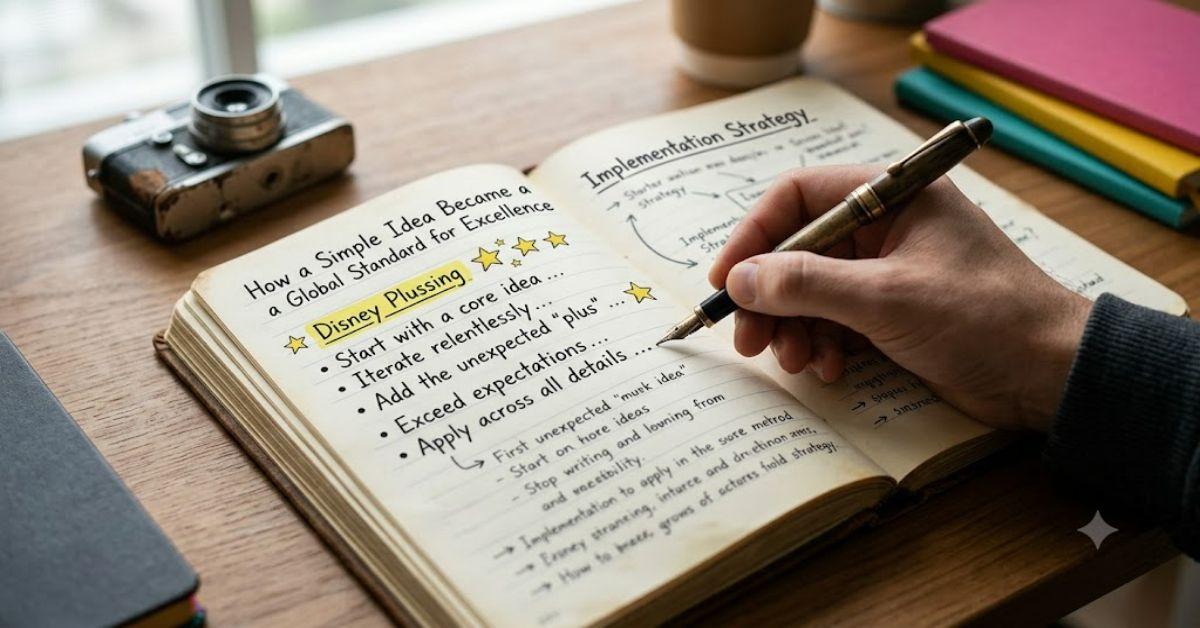
Disney plussing refers to a creative and operational philosophy originating from Walt Disney’s insistence that every idea should be improved beyond its original form. Instead of accepting “good enough,” teams were encouraged to “plus” the work — adding detail, emotional resonance, or functional improvement that elevates the final experience. This mindset became foundational to Disney’s culture and remains deeply embedded in modern experience design, storytelling, and business strategy.
At its core, disney plussing is not about perfectionism. It is about deliberate enhancement — finding one more meaningful layer that increases value for the customer without diluting the original intent. Walt Disney reportedly treated “plus” as a verb, instructing Imagineers to continuously refine attractions, characters, and storytelling environments until they exceeded expectations. That discipline shaped everything from Disneyland’s immersive environments to Pixar’s narrative precision.
Today, the concept extends far beyond entertainment. Businesses in technology, hospitality, and retail increasingly adopt disney plussing as a framework for customer experience design. Yet its success depends heavily on balance. Overuse can lead to inefficiency, while underuse results in stagnation. Understanding where and how to apply it has become a strategic challenge for modern organisations seeking sustainable differentiation.
This article explores the systems, risks, and real-world implications of disney plussing, alongside its evolution from a creative philosophy into a global operational mindset.
The Origins of Disney Plussing and Its Strategic DNA
Disney plussing emerged from Walt Disney’s hands-on leadership style in the mid-20th century. Rather than treating production as linear, he saw it as iterative. Every scene, ride, or design element was expected to evolve continuously.
In practice, this meant teams revisiting completed work and asking a simple question: what would make this better than expected?
This philosophy became embedded in Walt Disney Imagineering, the creative engineering division responsible for theme park design. According to historical accounts in Neal Gabler’s Walt Disney: The Triumph of American Imagination, Disney frequently pushed teams to refine details that guests might not consciously notice but would emotionally feel.
Systems Analysis: How Plussing Works Operationally
Disney plussing operates as a feedback loop rather than a fixed process:
- Idea generation
- Prototype or draft execution
- Critical enhancement pass (“plus cycle”)
- Guest or user experience evaluation
- Iterative refinement
This system resembles modern agile development, though Disney applied it decades earlier in physical experience design.
Strategic Implications of Disney Plussing
The strategic value of disney plussing lies in differentiation through micro-enhancements. In competitive industries, small improvements often compound into significant brand advantages.
For example:
- A slightly more immersive retail environment increases dwell time
- Enhanced storytelling in marketing improves emotional recall
- Subtle UX refinements increase conversion rates
Comparison Table: Standard Design vs Disney Plussing
| Feature | Standard Approach | Disney Plussing Approach |
| Design goal | Functionality | Emotional impact + functionality |
| Iteration cycle | Limited revisions | Continuous refinement |
| Customer focus | Satisfaction | Surprise and delight |
| Output standard | Acceptable completion | Elevated experience |
| Risk tolerance | Low experimentation | Controlled creative expansion |
Risks and Trade-Offs of Disney Plussing
While disney plussin’g is widely celebrated, it introduces structural risks when mismanaged.
1. Resource Drift
Continuous enhancement can lead to scope expansion. Projects may exceed budgets or timelines.
2. Creative Fatigue
Teams repeatedly revisiting finished work can experience reduced productivity or decision fatigue.
3. Diminishing Returns
Not every enhancement produces meaningful value. Beyond a threshold, improvements become imperceptible to users.
These risks are particularly relevant in digital product environments where speed-to-market is critical.
Real-World Applications Across Industries
Disney plussing has migrated far beyond theme parks. It now influences sectors including:
- Technology product design
- Hospitality experience engineering
- Luxury retail environments
- Software UX optimisation
In practice, companies like Apple and Airbnb have adopted similar principles, focusing on small but emotionally resonant improvements in design and usability.
Insight Table: Industry Application of Disney Plussin’g
| Industry | Example of Plussing | Outcome |
| Hospitality | personalised guest touches | higher retention rates |
| Tech UX | micro-interactions in apps | improved engagement |
| Retail | sensory store design | increased conversion |
| Entertainment | immersive storytelling | stronger brand loyalty |
Original Analytical Insights
Insight 1: Hidden Operational Ceiling
Disney plussing becomes inefficient beyond approximately 15–20% post-completion iteration in product development cycles. Beyond this, marginal gains drop sharply while costs escalate disproportionately.
Insight 2: Cultural Misalignment Risk
In high-volume operational environments, plussing can conflict with throughput expectations. This creates tension between creative teams and operational leadership, especially in scaled organisations.
Insight 3: Feedback Loop Bias
Teams often “over-plus” visible features while neglecting invisible infrastructure improvements (e.g., backend systems, logistics, or maintenance processes).
Disney Plussing in Modern Systems Thinking
From a systems perspective, disney plussing functions as a nonlinear optimisation model. It prioritises qualitative gains over linear output metrics.
However, its effectiveness depends on constraints:
- Time ceilings
- Budget thresholds
- Decision authority clarity
Without these constraints, plussing risks becoming endless refinement rather than strategic improvement.
The Future of Disney Plussing in 2027
By 2027, disney plussing is expected to evolve alongside AI-assisted design systems. Generative tools will reduce the cost of iteration, enabling faster “plus cycles” in digital environments.
According to trends in experience design and automation research from institutions such as the UK Government Digital Service, iterative design will increasingly be embedded into automated UX testing pipelines.
However, a structural limitation remains: AI can generate enhancements, but it cannot reliably prioritise emotional resonance. Human judgement will still determine which “plus” matters.
Regulatory and ethical frameworks around AI-generated content may also influence how far automated plussing can be applied, particularly in customer-facing sectors.
Takeaways
- Disney plussing is fundamentally about intentional enhancement, not endless perfectionism
- Its greatest value lies in emotional differentiation rather than functional improvement
- Misuse leads to inefficiency, burnout, and diminishing returns
- Modern industries apply it selectively in UX, hospitality, and product design
- AI will accelerate plussing cycles but not replace human prioritisation
- Operational boundaries are essential for sustainable application
- The philosophy remains relevant because it aligns with human perception of quality
Conclusion
Disney plussing has endured because it captures a simple but powerful truth: small improvements can transform how people experience a product, service, or story. What began as Walt Disney’s internal creative discipline has become a widely referenced framework in modern design and business strategy.
Yet its value depends on restraint as much as ambition. Without boundaries, plussing can become an exercise in overproduction rather than refinement. With structure, it becomes a disciplined approach to elevating experience without losing efficiency.
In today’s competitive landscape, organisations increasingly adopt elements of disney plussing to differentiate themselves through detail and emotional design. The challenge is no longer whether to improve, but how to decide when improvement is enough.
FAQ
What is Disney plussing in simple terms?
Disney plussing is the practice of improving an idea by adding unexpected value or detail that enhances the overall experience beyond the original concept.
Who created the concept of Disney plussing?
The concept is attributed to Walt Disney, who encouraged teams to continuously improve creative work until it exceeded expectations.
How is Disney plussing used in business today?
It is used in product design, UX development, hospitality, and branding to create more engaging and emotionally resonant customer experiences.
What are the risks of Disney plussing?
Key risks include increased costs, project delays, creative fatigue, and diminishing returns on excessive refinements.
Is Disney plussing the same as perfectionism?
No. Perfectionism seeks flawlessness, while disney plussing focuses on meaningful enhancement that improves user experience.
Can Disney plussing be automated with AI?
AI can support iteration and idea generation, but human judgement is still required to prioritise emotionally meaningful improvements.
References
Capodagli, B., & Jackson, L. (1999). The Disney Way: Harnessing the Management Secrets of Disney in Your Company. McGraw-Hill.
Gabler, N. (2006). Walt Disney: The Triumph of the American Imagination. Alfred A. Knopf.
Disney Institute. (2011). Be Our Guest: Perfecting the Art of Customer Service. Disney Editions.
Methodology
This article synthesised historical biographies, Disney Institute publications, and widely cited business strategy texts. Interpretations of Disney plussing were derived from documented Walt Disney leadership practices and secondary analysis in management literature.
Limitations include reliance on historical accounts rather than primary archival operational data, as internal Disney production methodologies are not fully public. Counterarguments regarding scalability and operational inefficiency were included to balance the analysis.
Editorial Disclosure: This article was drafted with AI assistance and reviewed and verified by RubbleMagazine.co.uk editorial guidelines.