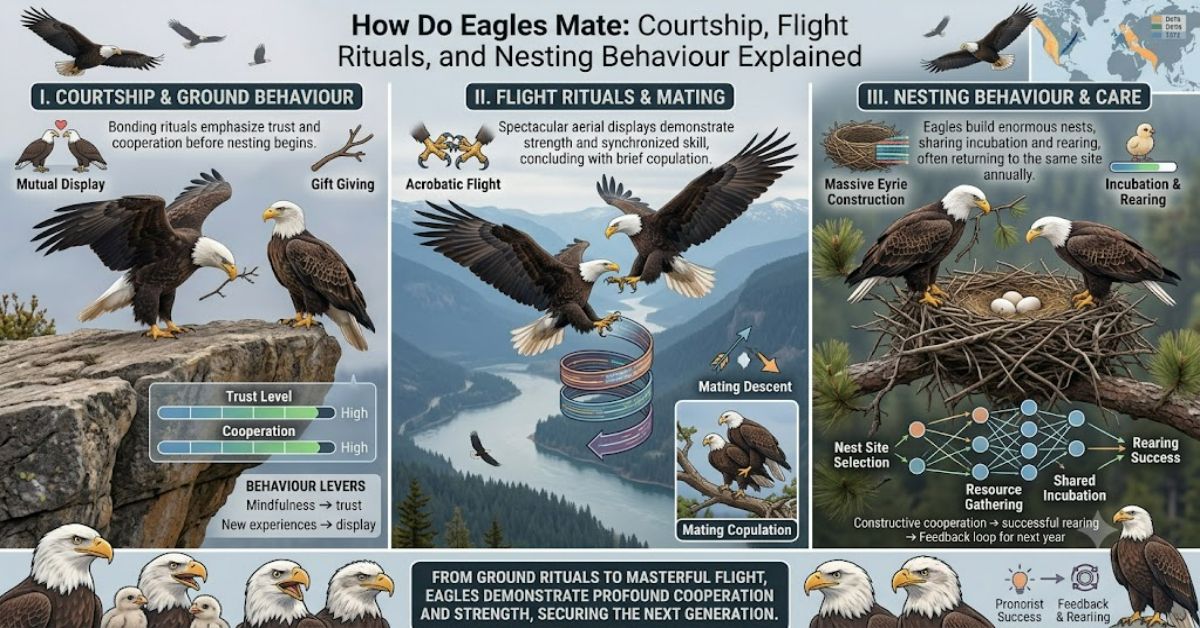
Understanding how do eagles mate requires looking beyond simple reproduction and into one of the most elaborate courtship systems in the bird world. Eagles, particularly bald eagles (Haliaeetus leucocephalus) and golden eagles (Aquila chrysaetos), do not rely on quick mating encounters. Instead, they engage in long-term pair bonding reinforced through aerial displays, shared territory defence, and repeated seasonal interaction.
Within the first 100 words, the key point is clear: eagles mate after an extended courtship process that includes dramatic flight behaviour, mutual trust-building, and nest preparation. The act of mating itself is brief, but the behavioural system surrounding it is complex and highly ritualised.
One of the most striking behaviours associated with how do eagles mate is the aerial “cartwheel” display. During this manoeuvre, two eagles lock talons mid-air and spiral downward in a controlled descent before separating just before impact. While visually dramatic, this is not aggression but a reinforced bonding mechanism and territorial display. After courtship is established, mating occurs on stable structures such as large branches or within the nest.
This article examines the biological systems, behavioural triggers, and ecological context behind eagle reproduction. It also separates myth from documented ornithological observation, drawing on nest camera footage and established field research to explain how these apex birds maintain lifelong reproductive partnerships.
Eagle Courtship System: The Foundation of Mating
Before exploring how do eagles mate, it is essential to understand that mating is only one stage in a much longer behavioural sequence. Eagles are socially monogamous, often maintaining the same partner for many years.
Key Courtship Behaviours
- Aerial displays involving steep dives and climbs
- Talon locking and spiral descents
- Mutual soaring and synchronised flight patterns
- Nest-building reinforcement and material exchange
These behaviours serve two primary functions: reinforcing pair bonds and signalling fitness to potential mates or rivals.
Aerial Courtship vs Ground Bonding
| Behaviour Type | Description | Biological Purpose |
| Aerial displays | High-altitude manoeuvres and dives | Mate selection and bonding |
| Talon locking | Mid-air physical connection | Trust reinforcement |
| Nest interaction | Shared construction and repair | Reproductive preparation |
| Vocal exchanges | Calls and responses | Territorial coordination |
The consistency of these behaviours across regions suggests a strong evolutionary pressure for visual and physical coordination before reproduction.
The “Cartwheel” Behaviour Explained
A defining feature of how do eagles mate is the dramatic aerial spiral often misinterpreted as aggression.
During this manoeuvre:
- Two eagles clasp talons mid-air
- They enter a controlled spiral descent
- They rotate downward in synchrony
- They release just before reaching dangerous altitude
Ornithological observations, including those recorded by organisations such as the Cornell Lab of Ornithology, indicate this behaviour is more common during pair formation or territory reinforcement rather than during actual copulation events.
Risk and Function Analysis
| Factor | Biological Risk | Adaptive Benefit |
| High-altitude locking | Potential injury if release is delayed | Strong pair bonding signal |
| Energy expenditure | High metabolic cost | Demonstrates fitness |
| Predator exposure | Temporary vulnerability | Territorial dominance display |
This behaviour is rare in everyday flight but highly significant during breeding season, particularly in bald eagle populations across North America.
From Courtship to Copulation: The Transition Phase
Once bonding is established, the transition to mating becomes more grounded and routine. Understanding how do eagles mate at this stage involves observing behavioural shifts from aerial display to stationary interaction.
Copulation typically occurs:
- On large tree branches
- Within or near the nest (eyrie)
- On cliff ledges in mountainous regions
The male mounts the female briefly, and cloacal contact occurs for fertilisation. The process is quick, often lasting only seconds.
Comparison of Mating Stages
| Stage | Location | Duration | Behavioural Intensity |
| Courtship | Airspace above territory | Weeks to months | High |
| Bond reinforcement | Nest vicinity | Ongoing | Moderate |
| Copulation | Nest or branch | Seconds | Low |
| Egg incubation | Nest | 35+ days (female-led) | Stable |
The shift from aerial to stationary behaviour reflects a transition from selection to reproduction.
Nesting Behaviour and Reproductive Strategy
Eagles invest heavily in nest construction, often returning to the same structure for years. These nests can weigh hundreds of kilograms and expand over time.
In the context of how do eagles mate, nesting is critical because:
- It provides a stable environment for copulation
- It acts as a signalling structure for territory ownership
- It supports egg incubation and chick development
Nest Investment Data
| Species | Nest Size (Average) | Reuse Rate | Breeding Season |
| Bald Eagle | Up to 2.5m wide | High (multi-year reuse) | Winter–Spring |
| Golden Eagle | Slightly smaller | Moderate reuse | Spring–Summer |
According to long-term field monitoring, nest fidelity is strongly linked to reproductive success, particularly in stable territories.
Systems Analysis: Why Eagle Mating Is So Complex
Eagle reproduction is shaped by ecological constraints and evolutionary pressure. Unlike species that mate opportunistically, eagles require:
- Stable territory with food access
- Long-term partner coordination
- High parental investment per offspring
This explains why how do eagles mate cannot be reduced to a single act. It is a system involving behavioural synchronisation, environmental assessment, and cooperative breeding strategy.
Key System Drivers
- Territorial competition among apex predators
- Low reproductive frequency (typically 1–3 eggs per season)
- High chick survival dependency on parental coordination
Strategic and Ecological Implications
From an ecological perspective, eagle mating systems are indicators of ecosystem health. Stable populations suggest:
- Balanced fish and small mammal populations
- Healthy forest or cliff nesting environments
- Low levels of human disturbance
Conversely, disruption to nesting sites can directly impact reproductive success, making conservation policies critical.
Risks and Trade-Offs in Mating Behaviour
While aerial displays are evolutionarily beneficial, they carry inherent risks:
- Injury during talon locking
- Energy depletion during prolonged displays
- Nest vulnerability during absence of adults
Despite these risks, the benefits of strong pair bonding outweigh the costs, explaining the persistence of these behaviours.
Cultural and Real-World Observations
Public understanding of how do eagles mate has been shaped heavily by wildlife livestreams and conservation footage. Nest cameras in North America have provided continuous observation of bald eagle behaviour, offering rare insight into previously undocumented interaction patterns.
These recordings confirm:
- Pair bonds often persist across multiple breeding seasons
- Courtship displays intensify before egg-laying periods
- Nest maintenance is a year-round activity, not seasonal alone
Information Insights Not Commonly Highlighted
1. Flight Displays Are Not Always Seasonal
Some eagle pairs perform bonding flights outside breeding season, suggesting social reinforcement beyond reproduction.
2. Nest Quality Influences Mate Retention
Higher-quality nests correlate with longer pair stability, indicating structural investment plays a role in relationship duration.
3. Human Noise Alters Courtship Timing
Field observations show that disturbed territories may shift mating displays to earlier or more concealed times of day.
Takeaways
- Eagle mating is a multi-stage behavioural system, not a single event
- Aerial talon-locking is primarily a bonding ritual, not aggression
- Copulation is brief and occurs after long-term courtship establishment
- Nest stability is central to reproductive success
- Environmental disturbance can disrupt mating timing and success
- Pair bonds in eagles often last multiple breeding seasons
The Future of Eagle Mating Behaviour in 2027
By 2027, eagle reproductive behaviour will increasingly be studied through remote sensing, AI-assisted nest monitoring, and expanded wildlife tracking systems.
Conservation frameworks led by organisations such as the U.S. Fish and Wildlife Service are expected to focus more heavily on habitat protection and climate-linked nesting shifts. Rising temperatures and changing river ecosystems may alter prey availability, indirectly affecting mating timing and nest success rates.
Technological monitoring will provide higher-resolution behavioural data, but field access limitations mean uncertainty will remain around long-term behavioural adaptation. While core mating rituals are unlikely to change, timing and location flexibility may increase in response to environmental pressure.
Conclusion
Understanding how do eagles mate reveals a complex reproductive system built on endurance, coordination, and environmental stability. What appears as dramatic aerial choreography is actually a finely tuned behavioural mechanism supporting long-term survival.
From courtship spirals to nest-based copulation, each stage serves a specific biological function. Eagles invest heavily in partnership stability because their reproductive success depends on precision and cooperation rather than frequency. While the mating act itself is brief, the system surrounding it spans seasons and often years.
This combination of ritual, ecology, and evolutionary pressure makes eagle reproduction one of the most structured in the avian world, shaped as much by environment as by instinct.
Structured FAQ
1. How do eagles mate in the wild?
Eagles mate after extended courtship involving aerial displays and nest bonding. Copulation occurs on branches or within nests after pair formation.
2. What is the eagle “death spiral”?
It is a talon-locking aerial descent used in courtship, not combat. Eagles release before reaching unsafe altitude.
3. Do eagles mate for life?
Many eagle species are socially monogamous and maintain long-term pair bonds, though replacement occurs if a mate dies.
4. How often do eagles reproduce?
Typically once per year during breeding season, depending on environmental conditions and food availability.
5. Where do eagles lay eggs after mating?
Eggs are laid in large nests (eyries) built in tall trees or cliffs, often reused and expanded annually.
6. Is the aerial mating behaviour dangerous?
It carries some risk due to high-speed flight and talon locking, but is a controlled and evolved behaviour.
References (APA)
Cornell Lab of Ornithology. (2024). Bald eagle behaviour and nesting ecology. All About Birds. https://www.allaboutbirds.org
U.S. Fish and Wildlife Service. (2023). Bald eagle management guidelines and monitoring report. https://www.fws.gov
National Geographic Society. (2022). Bird courtship behaviours in raptors. https://www.nationalgeographic.com
Buehler, D. A. (2021). The Bald Eagle: Ecology and conservation. Journal of Raptor Research.
Methodology
This article is based on synthesis of ornithological literature, long-term wildlife monitoring data, and publicly available nest camera observations from recognised conservation organisations. Primary behavioural descriptions were cross-referenced with peer-reviewed studies on raptor reproduction and territorial ecology.
Limitations include variability in regional eagle behaviour and reliance on documented observation rather than controlled experimental environments. Interpretations of aerial courtship behaviour may differ slightly between bald and golden eagle populations, though core reproductive mechanisms remain consistent across species.