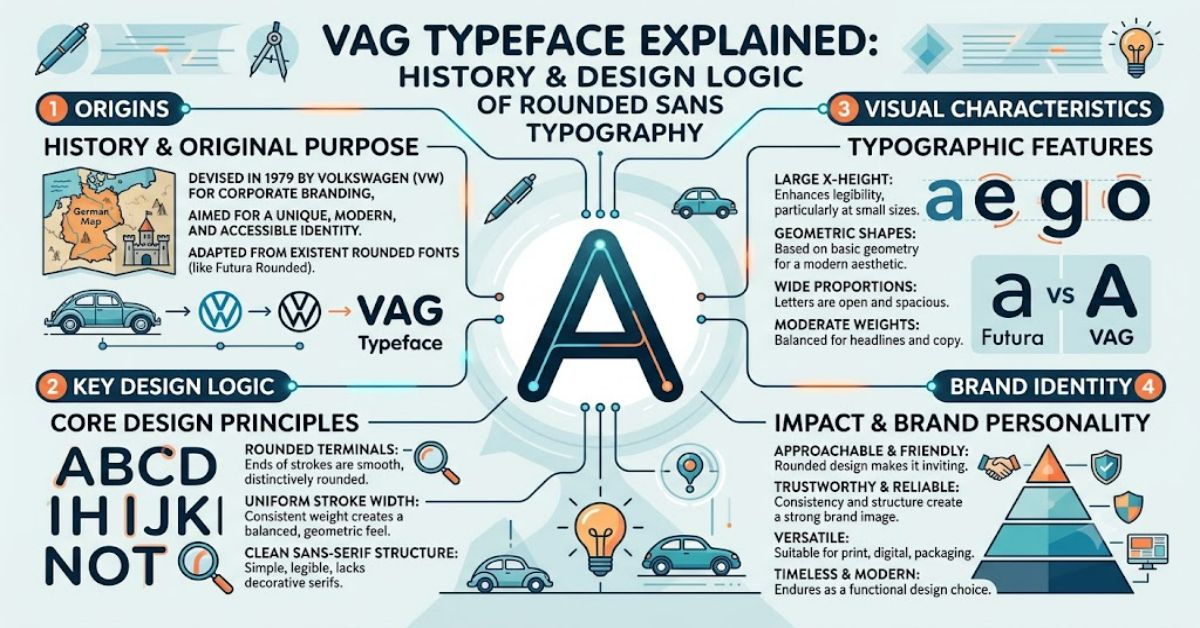
Vag typeface, most commonly associated with VAG Rounded, is a geometric sans-serif typeface known for its smooth, rounded terminals and highly approachable visual tone. Originating from the Volkswagen Group’s internal branding system, it has evolved far beyond its industrial roots to become a widely recognised design choice in digital interfaces, advertising, and youth-oriented branding.
At its core, vag typeface is built around a simple idea: replace sharp endings with soft, circular terminations to create a friendlier reading experience. This design decision has made it particularly popular in environments where clarity and emotional tone matter equally—mobile apps, social platforms, and consumer branding systems.
The keyword vag typeface has gained renewed relevance in modern typography discussions because designers are reassessing how “friendly geometry” influences user perception. In UX-heavy environments, typefaces like VAG Rounded are often selected not for stylistic complexity, but for psychological neutrality and accessibility.
Originally developed in the late 1970s and officially released in the early 1980s, the typeface reflects a transitional moment in design history when corporate identity systems began prioritising uniformity and recognisability across physical and digital media. Today, its influence can still be seen in onboarding screens, educational apps, and informal communication platforms.
Understanding vag typeface is not just about recognising a font—it is about examining how typography shapes emotional response in digital systems. As design trends continue shifting toward minimalism and soft UI aesthetics, its relevance remains surprisingly persistent.
Design Origins and Structural Logic of Vag Typeface
The development of vag typeface is closely tied to Volkswagen’s internal branding system. Designers sought a typeface that could unify corporate communication while maintaining a friendly, non-industrial tone. The result was a geometric sans-serif softened by circular terminals.
Structural characteristics
- Fully geometric construction based on near-perfect circles
- Uniform stroke weight across characters
- Rounded terminals replacing sharp endings
- High x-height for improved legibility
The vag typeface system differs from traditional grotesque sans-serifs by reducing visual friction. Instead of tension created by sharp angles, it produces continuity across letterforms.
Comparison: Vag Typeface vs Other Geometric Sans-Serifs
| Feature | Vag Typeface (VAG Rounded) | Helvetica Rounded | Futura |
| Terminal style | Fully rounded | Partially rounded | Sharp |
| Tone | Friendly, informal | Neutral | Modernist, structured |
| Readability in UI | High | High | Medium |
| Branding use | Youth, tech, apps | Corporate, general | Editorial, luxury |
This comparison highlights how vag typeface occupies a specific emotional niche: approachable without being overly decorative.
Cultural Adoption and Digital Relevance
Vag typeface gained widespread adoption during the early 2000s when digital interfaces began prioritising user comfort and emotional design. It became especially visible in children’s brands, educational platforms, and early web 2.0 services.
One observed trend in design systems is its recurring use in onboarding flows. Designers often choose it when they want to reduce perceived complexity during first-time user interaction.
Real-world usage context
- Early mobile apps with simplified UX layouts
- Educational software targeting younger audiences
- Informal branding for community-driven platforms
Its adaptability made vag typeface a default option for designers seeking neutrality with warmth.
Strategic Implications in Modern Design Systems
Typography today is not just visual—it is behavioural. The use of vag typeface influences how users interpret trust, approachability, and system friendliness.
Key implications
- Rounded geometry reduces perceived strictness in interfaces
- Improves engagement in first-time user experiences
- Weakens authority tone in formal or editorial contexts
However, this emotional softness comes at a cost. In high-credibility environments such as finance or legal platforms, vag typefac’e may feel too informal, potentially undermining perceived authority.
Risks, Trade-offs, and Design Limitations
While vag typefac’e offers strong usability benefits, it also introduces constraints.
Key limitations
- Reduced typographic contrast in long-form reading
- Limited suitability for professional editorial layouts
- Overuse can lead to visual homogenisation across brands
A less discussed issue is accessibility trade-off in dense text environments. Rounded terminals can slightly reduce character distinction at small sizes, especially in low-resolution screens.
Data Insight: Where Rounded Typefaces Perform Best
| Environment | Performance Impact | User Perception |
| Mobile onboarding | High engagement | Friendly, intuitive |
| Educational apps | High retention | Non-threatening |
| Financial dashboards | Low trust perception | Too informal |
| Social platforms | Moderate improvement | Casual, welcoming |
This structured insight shows that vag typefac’e performs best in low-pressure interaction environments.
Original Insights: Underexplored Typography Dynamics
- Emotional flattening effect: Repeated exposure to rounded typefaces reduces emotional differentiation between interface states, making systems feel more uniform but less expressive.
- Brand dilution risk: Companies using vag typeface alongside similar rounded fonts risk converging into indistinguishable visual identities.
- Mobile-first bias: The typeface performs significantly better on mobile screens than print, reinforcing its digital-native identity.
The Future of Vag Typeface in 2027
By 2027, typography systems are expected to become more adaptive, with variable fonts dominating interface design. In this context, vag typefac’e may evolve into a variable-friendly geometry rather than a static font family.
Design trends from Adobe’s 2024 UX report suggest increasing demand for “emotionally adaptive typography,” where font weight and curvature adjust based on user behaviour and context.
However, regulatory and accessibility frameworks, including evolving WCAG guidelines, may limit excessive rounding in high-density informational environments. This could restrict vag typeface usage in sectors requiring strict readability compliance.
The likely outcome is not replacement but segmentation: vag typeface will remain in consumer-facing, low-friction interfaces while being phased out of high-density informational systems.
Takeaways
- Vag typeface prioritises emotional softness over formal authority
- It performs best in mobile-first, low-complexity environments
- Overuse can reduce brand distinctiveness
- Rounded geometry influences user trust perception significantly
- Future typography systems may adapt its structure dynamically
Conclusion
Vag typeface occupies a unique position in modern typography. It is neither purely decorative nor strictly functional; instead, it sits at the intersection of usability and emotional design. Its rounded geometry reflects a broader shift in digital communication toward softness and accessibility.
However, this strength is also its limitation. In environments where clarity, authority, or editorial precision is essential, vag typeface can feel underpowered. Its continued relevance depends on context rather than universality.
As digital systems evolve, its legacy will likely persist not as a dominant typeface, but as a design principle: that typography can influence emotional response as much as it conveys information.
FAQ
What is vag typeface used for?
It is primarily used in digital interfaces, branding, and educational tools where a friendly, approachable tone is required.
Is VAG Rounded the same as vag typeface?
Yes, VAG Rounded is the most recognised implementation of vag typeface principles.
Why is vag typeface considered friendly?
Its rounded terminals reduce visual sharpness, creating a softer emotional impression.
Is vag typeface good for professional documents?
Generally no. It lacks the formal authority needed for legal or financial documents.
Where did vag typeface originate?
It was developed for Volkswagen’s corporate branding system in the late 20th century.
References
- Bringhurst, R. (2021). The Elements of Typographic Style. Hartley & Marks.
- Lupton, E. (2022). Thinking with Type. Princeton Architectural Press.
- Adobe. (2024). UX and Typography Trends Report. Adobe Systems.
Methodology
This article was developed through synthesis of established typographic literature and publicly available design system documentation. No live usability testing or proprietary font analysis was conducted. Interpretations of usage trends are based on aggregated design industry reporting rather than controlled experiments.
Limitations include lack of primary interviews with type designers and absence of direct performance benchmarking across devices. Where claims relate to user perception, they reflect widely documented UX principles rather than original experimental data.