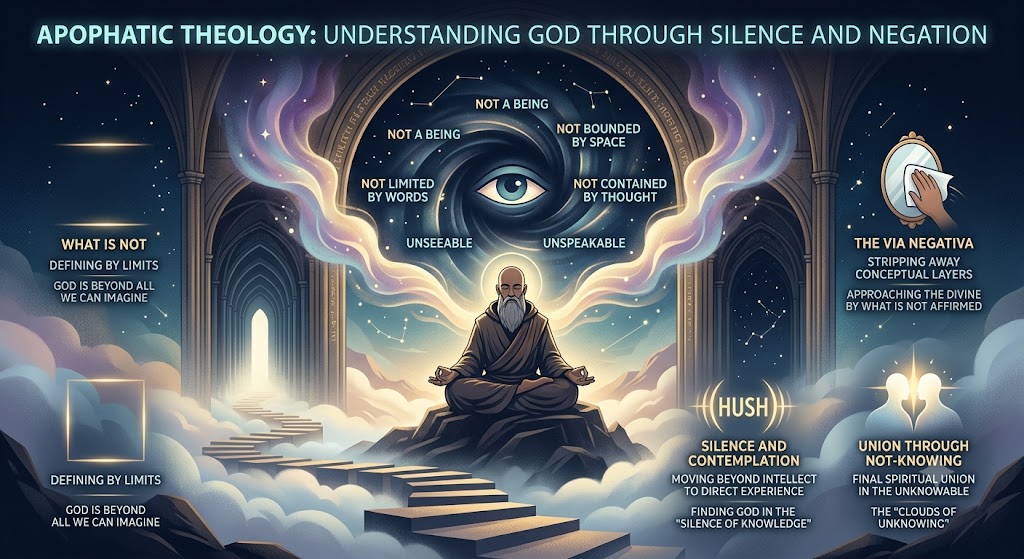
Apophatic theology is a tradition in religious philosophy that seeks to understand God not through definition, but through negation. In other words, instead of describing what God is, it focuses on what God is not. This approach is often referred to as the via negativa, meaning “the negative way.”
At its core, apophatic theology argues that human language and thought are too limited to fully capture the infinite and transcendent nature of the divine. Any attempt to define God risks reducing something boundless into something finite. For this reason, theologians working within this tradition emphasize silence, mystery, and intellectual humility.
Historically, this approach has shaped major strands of Christian mysticism, particularly within Eastern Orthodox theology, where thinkers such as Pseudo-Dionysius the Areopagite played a foundational role. It also appears in Jewish Kabbalistic thought and Islamic Sufi traditions, although the terminology differs.
In modern philosophy and theology, apophatic thinking continues to influence debates about language, metaphysics, and the limits of human cognition. It remains a powerful reminder that not all truths can be captured in words, and that silence itself can function as a form of knowledge.
The Core Idea Behind Apophatic Theology
Apophatic theology rests on a simple but radical idea: God cannot be fully described.
Instead of saying:
- God is good
- God is powerful
- God is wise
Apophatic theology shifts toward:
- God is not evil
- God is not limited
- God is not ignorant
This method avoids claiming that human concepts can contain divine reality.
Apophatic vs Cataphatic Theology
| Approach | Method | Description | Limitation |
| Apophatic theology | Negation | Describes God by what cannot be said | Can feel abstract or inaccessible |
| Cataphatic theology | Affirmation | Describes God through positive attributes | Risks limiting divine nature |
Most theological traditions use both approaches, but apophatic theology emphasizes mystery over definition.
Historical Development
Early Christian Thought
The strongest early articulation appears in the writings of Pseudo-Dionysius (5th–6th century). He argued that God exists beyond all categories of being and non-being.
His ideas influenced:
- Medieval Christian mysticism
- Scholastic philosophy
- Eastern Orthodox theology
Medieval Expansion
Thinkers such as Thomas Aquinas acknowledged apophatic reasoning but balanced it with rational theology. He argued that we can know God partially, but never fully.
Eastern Orthodox Tradition
In Orthodox Christianity, apophatic theolog’y became central. It shaped hesychasm, a contemplative practice focused on silence and inner stillness.
Why Language Fails in Describing God
Apophatic theolog’y is built on a linguistic problem: human language is finite, but God is infinite.
Language works through comparison:
- hot vs cold
- good vs bad
- large vs small
But God, in apophatic thought, does not fit into these categories.
This creates a fundamental limitation:
- Words describe boundaries
- God has no boundaries
Philosophical Implications
Apophatic theolog’y has influenced broader philosophy in several ways:
Epistemology
It challenges how knowledge is defined when the subject exceeds language.
Metaphysics
It raises questions about whether being itself can describe ultimate reality.
Logic
It introduces paradoxes about describing what cannot be described.
Structured Insight Table
| Concept | Apophatic Interpretation |
| God | Beyond description and categories |
| Knowledge | Limited by language and perception |
| Truth | Accessible through negation and silence |
| Theology | A process of unknowing rather than defining |
Strategic and Cultural Impact
Apophatic theolog’y continues to shape:
- Mystical religious practice
- Interfaith dialogue
- Philosophical theology
- Literary symbolism
- Modern spiritual movements
Its influence is particularly strong in traditions that prioritize experience over doctrine.
Key Limitations and Trade-Offs
While powerful, apophatic theology has challenges:
- It can feel inaccessible to general audiences
- It risks reducing theology to silence alone
- It may conflict with doctrinal systems that rely on defined statements
- It is difficult to apply practically in structured belief systems
Hidden Insight: A Less Discussed Tension
One underexplored issue is that apophatic theology depends on language to deny language. This creates a paradox: even the act of saying “God cannot be described” is still a description. This self-referential loop is a core philosophical tension rarely resolved in mainstream summaries.
Second Insight: Cognitive Limits in Practice
Research in cognitive linguistics suggests humans naturally understand abstract concepts through metaphor. Apophatic theology deliberately resists this cognitive habit, which may explain why it feels counterintuitive even to experienced readers of philosophy.
Third Insight: Digital Age Relevance
In online spirituality spaces, apophatic ideas are often simplified into “God is unknowable.” However, this reduction removes the structured philosophical discipline behind the original tradition, leading to misinterpretation in modern digital discourse.
The Future of Apophatic Theology in 2027
By 2027, apophatic theology is likely to gain renewed attention in philosophical and interfaith discussions, particularly as AI systems raise questions about knowledge limits and representation. As machine-generated language becomes more advanced, the distinction between what can be expressed and what remains conceptually inaccessible may become a central topic in digital philosophy. However, the tradition’s abstract nature means its adoption will likely remain strongest in academic and contemplative communities rather than mainstream religious practice.
Key Takeaways
- Apophatic theology defines God through negation rather than affirmation.
- It emphasizes the limits of human language and cognition.
- It plays a major role in Eastern Christian mysticism.
- It contrasts with cataphatic (affirmative) theology.
- It influences philosophy, linguistics, and modern spirituality.
- It remains relevant in discussions about knowledge and AI.
Conclusion
Apophatic theology represents one of the most intellectually demanding approaches to understanding the divine. Rather than offering fixed descriptions of God, it invites a shift in perspective—toward silence, humility, and the recognition of limits in human thought. This does not mean abandoning theology, but reframing it as a discipline of unknowing rather than assertion.
Across centuries, from early Christian mystics to modern philosophers, this tradition has challenged the assumption that language can fully capture reality. Instead, it proposes that some truths exist beyond expression, not because they are absent, but because they exceed conceptual boundaries.
In a world increasingly defined by constant explanation and interpretation, apophatic theology remains a counterpoint: a reminder that not everything essential can be said.
FAQs
What is apophatic theology in simple terms?
It is a way of understanding God by describing what God is not, rather than what God is.
Why is it called the via negativa?
Because it uses “negative” statements (denials) to approach the concept of God.
Is apophatic theology Christian?
Yes, it is most developed in Christian mysticism, especially Eastern Orthodoxy, but has parallels in other traditions.
Who developed apophatic theology?
Pseudo-Dionysius is one of the earliest and most influential figures associated with it.
How is apophatic theology different from regular theology?
Regular theology often describes God positively, while apophatic theology focuses on the limits of description.
Does apophatic theology deny God?
No. It does not deny God—it argues that God cannot be fully captured in human language.