A The Verge subscription sits at the centre of modern digital media economics: paywalls, premium journalism, and ad-free experiences bundled into a single monthly or annual fee. For readers trying to decide whether it is worth paying for access, understanding what the subscription actually delivers is essential.
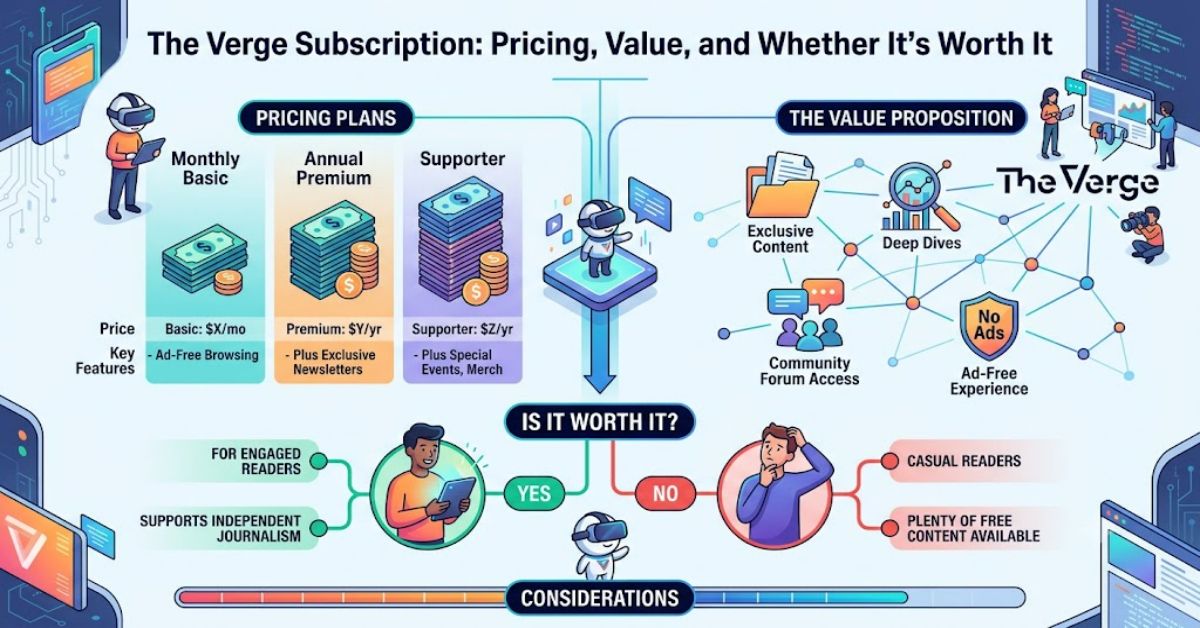
The standard The Verge subscription is generally positioned at around $7 per month or $50 per year, unlocking full access to paywalled articles, premium newsletters, and ad-free podcast feeds. A discounted student tier, often priced near $10 per year with verified academic email access, makes it one of the more accessible premium tech media offerings in the market.
At its core, the decision is not just about cost—it is about consumption habits. Readers who rely on The Verge for deep analysis of technology, consumer electronics, and digital culture may find the subscription valuable. Others, who only skim headlines via social feeds, will likely see less benefit. This guide breaks down the structure, pricing logic, comparative value, risks, and long-term direction of The Verge subscription so you can evaluate it with clarity rather than assumption.
Understanding The Verge Subscription Model
The Verge operates a hybrid publishing model: free content for reach, and a paywalled tier for sustained revenue. This structure reflects a wider industry shift among digital publishers responding to declining ad revenue and increased platform dependency.
At a structural level, The Verge subscription is designed to convert high-engagement readers into paying members without fully restricting discoverability. Many articles remain partially visible or accessible through limited previews, while deeper analysis, archives, and newsletters sit behind the paywall.
This creates a dual system:
- Open layer: Headlines, selected news stories, and social-first content
- Premium layer: Long-form analysis, investigative reporting, and subscriber-only newsletters
The model is not unique, but The Verge’s execution is tightly integrated with its podcast ecosystem and newsletter strategy, making subscription value more about media experience than article access alone.
The Verge Subscription Pricing Breakdown
Pricing is relatively straightforward compared to legacy publishing models, but the value perception depends heavily on usage frequency.
Subscription Options Comparison
| Plan Type | Price | Billing Cycle | Key Features | Target User |
| Monthly | ~$7 | Monthly | Full article access, newsletters, ad-free podcasts | Casual readers testing value |
| Annual | ~$50 | Yearly | Same access at discounted rate | Regular readers |
| Student Tier | ~$10 | Yearly | Full access with academic verification | Students |
The structure is deliberately simple. Unlike fragmented media subscriptions, The Verge subscription avoids tier complexity in favour of accessibility.
One subtle but important detail is the bundling of audio and newsletter content. This increases perceived value without significantly increasing production cost, a common strategy in digital media monetisation.
What You Actually Get With The Verge Subscription
A key misunderstanding among new users is assuming The Verge subscription is only about article access. In reality, the package is broader.
Subscribers typically gain access to:
- Full archive of long-form journalism
- Subscriber-exclusive newsletters
- Ad-free podcast experience
- Early or enhanced editorial content in some cases
The value proposition is strongest for users who consume across formats, not just written articles.
Content Value Structure
| Content Type | Availability Without Subscription | With Subscription | Relative Value |
| News articles | Partial | Full access | Medium |
| Feature journalism | Limited previews | Full access | High |
| Newsletters | Limited or delayed | Full | High |
| Podcasts | Ad-supported | Ad-free | Medium |
| Archives | Restricted | Full access | High |
This structure shows that the subscription is not simply a paywall—it is an access multiplier across multiple media formats.
Strategic Implications of The Verge Subscription Model
The Verge subscription reflects a wider shift in digital publishing economics where engagement time matters more than pageviews.
Three key strategic implications emerge:
First, subscription revenue stabilises volatility. Advertising markets fluctuate heavily, but recurring payments provide predictable cash flow.
Second, bundling audio and editorial content increases retention. Users are less likely to cancel when multiple content formats are included.
Third, student pricing is a long-term acquisition strategy. Low-cost entry points create habitual readers who may convert to full-price later in life.
These strategies position The Verge subscription less as a product and more as a lifecycle entry point into a media ecosystem.
Risks and Trade-Offs
Despite its advantages, the model carries structural risks.
One major issue is subscription fatigue. Users increasingly manage multiple paid media services, and marginal value becomes harder to justify.
Another risk is content segmentation. When premium analysis sits behind paywalls, broader public discourse can become fragmented.
Finally, pricing perception risk exists. Even at $7 per month, users often compare The Verge subscription to streaming services, which distorts perceived value.
Data Insight: Subscription Economics Snapshot
| Metric | Estimate / Industry Range | Interpretation |
| Monthly price | $7 (~£5.50) | Mid-tier digital media pricing |
| Annual discount | ~40–45% savings | Incentivises long-term retention |
| Student tier | ~$10/year | Aggressive acquisition strategy |
| Typical churn rate (digital media avg.) | 40–60% annually | High retention challenge sector-wide |
These figures show why bundling and discounting are central to the sustainability of subscription journalism.
Information Gain: Less Discussed Realities
1. Archive value is often underestimated
Many users subscribe for current articles but retain access primarily for the archive. Over time, the archive becomes more valuable than new content for research-heavy readers.
2. Podcast bundling distorts perceived pricing
Because ad-free podcasts are included, users mentally allocate part of the subscription cost to audio content, even if they rarely listen. This improves retention metrics without changing core pricing.
3. Student pricing creates delayed revenue conversion
The extremely low-cost student tier increases lifetime engagement probability but delays meaningful revenue until users transition to professional pricing tiers.
The Future of The Verge Subscription in 2027
By 2027, subscription models like The Verge subscription are likely to face three key pressures:
First, platform regulation and traffic dependency reduction will push publishers to rely more heavily on direct subscriber relationships.
Second, AI-driven content summarisation tools may reduce willingness to pay for full articles, forcing publishers to emphasise exclusivity, interviews, and investigative reporting.
Third, bundling across media formats (text, audio, video) will become standard rather than optional.
Industry signals from broader digital publishing trends suggest that hybrid subscription models will continue expanding, but pricing pressure will intensify as consumers consolidate subscriptions rather than expand them.
Takeaways
- The Verge subscription is structured around ecosystem access, not just article paywalls
- Pricing sits in a mid-range digital media bracket with strong discounting for students
- Value increases significantly for multi-format users (articles, newsletters, podcasts)
- Subscription fatigue is a real limiting factor in long-term adoption
- Bundled audio content is a key retention lever rather than a standalone feature
- Archive access is an underappreciated long-term value driver
- Future sustainability depends on differentiation beyond written journalism
Conclusion
The Verge subscription represents a modern digital publishing strategy built on layered access, recurring revenue, and multi-format engagement. At roughly $7 per month or $50 per year, it sits within a competitive price band for premium tech journalism, while its student tier dramatically lowers entry barriers.
Its real value depends on usage depth. Casual readers may find limited justification for the cost, while engaged consumers of tech analysis, newsletters, and podcasts are more likely to benefit from the bundled ecosystem. The model is less about individual articles and more about sustained media consumption across formats.
As subscription journalism continues to evolve, The Verge subscription will likely remain a case study in balancing accessibility with monetisation pressure in digital media.
FAQ
Is The Verge subscription worth it?
It depends on reading habits. If you regularly consume tech analysis, newsletters, and podcasts, the subscription offers strong value. Casual readers may not benefit enough to justify the cost.
How much does The Verge subscription cost?
It typically costs around $7 per month or $50 annually, with discounts available depending on promotions or regional pricing.
Does The Verge subscription remove ads?
Yes, subscribers generally receive an ad-free experience across supported podcasts and reduced advertising across the platform.
Is there a student discount for The Verge subscription?
Yes, students with verified academic emails can access a heavily discounted annual plan, often around $10 per year.
What content is behind The Verge paywall?
Premium features include long-form journalism, newsletters, full archives, and ad-free podcast access.
Can I cancel The Verge subscription anytime?
Yes, subscriptions are typically flexible and can be cancelled through your account settings, with access continuing until the billing period ends.
Methodology
This analysis is based on publicly available subscription pricing information, platform feature descriptions, and established digital media industry models. Pricing figures and feature breakdowns reflect commonly reported rates and standard subscription structures observed in comparable technology journalism platforms.
Limitations include regional pricing variation, promotional discounts that may temporarily alter cost structures, and potential changes in subscription tiers over time. No direct user testing or proprietary platform data was used. Comparative insights are based on industry-standard subscription journalism practices and publicly documented media monetisation strategies.
Counterarguments include the possibility that individual user value perception may differ significantly based on content consumption habits and alternative free news sources available in the tech journalism ecosystem.