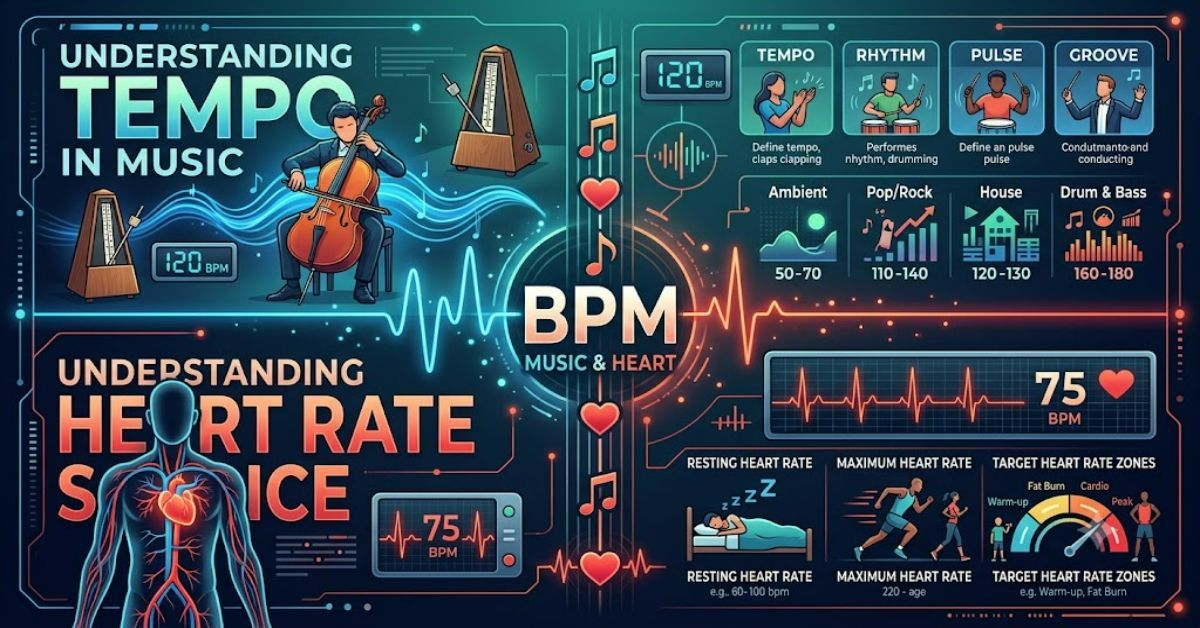
Understanding beats per minute is essential in both music and health because it describes how frequently a repeating event occurs within one minute. In music, beats per minute defines tempo—how fast or slow a composition feels. In health contexts, beats per minute measures heart rate, a key indicator of cardiovascular function. This dual usage makes BPM one of the most widely applied measurement systems across disciplines.
When musicians refer to beats per minute, they are describing tempo units such as 60 BPM (slow, steady rhythm) or 120 BPM (common dance tempo). In medical and fitness contexts, beats per minute reflects how many times the heart contracts in one minute, with a typical adult resting range between 60–100 BPM according to NHS guidance.
The keyword beats per minute therefore sits at the intersection of art and biology. Both systems rely on rhythm, repetition, and timing, yet they serve very different purposes. In music, BPM structures emotional experience and synchronisation. In health, it provides critical diagnostic information about cardiovascular efficiency.
Understanding how to interpret beats per minute across these domains helps improve everything from exercise performance to musical composition. It also reveals how human perception of rhythm is deeply connected to physiological processes.
What Beats Per Minute Means in Music and Health
Beats per minute is a unit of measurement describing frequency over time. Despite its simplicity, its interpretation varies significantly depending on context.
Comparison: Music BPM vs Heart Rate BPM
| Feature | Music BPM | Heart Rate BPM |
| Purpose | Tempo measurement | Physiological monitoring |
| Unit function | Rhythmic timing | Cardiac cycles |
| Typical range | 40–200+ BPM | 60–100 BPM (resting adult) |
| Control | Human/composer | Autonomic nervous system |
| Output type | Audio rhythm | Biological signal |
In both cases, BPM provides a structured rhythm, but only one is consciously controlled.
How BPM Works in Music Composition
In music production, beats per minute defines the temporal structure of a track. A higher BPM produces faster rhythmic patterns, while a lower BPM creates slower, more spacious compositions.
Common BPM Ranges in Music
| Genre | BPM Range | Rhythmic Character |
| Ambient | 40–70 BPM | Slow, atmospheric |
| Hip-hop | 70–100 BPM | Moderate groove |
| Pop | 100–130 BPM | Steady, commercial |
| EDM | 120–150 BPM | High energy |
| Drum & Bass | 160–180 BPM | Fast-paced intensity |
A track set at 120 BPM means there are 120 beats occurring per minute, typically mapped to a 4/4 time signature.
BPM in Human Physiology
In medical terms, beats per minute refers to heart rate—the number of heart contractions per minute.
According to the National Health Service (NHS, 2023), a normal adult resting heart rate typically falls between 60 and 100 BPM. Athletes may have lower resting rates due to improved cardiovascular efficiency.
Heart Rate Insight Table
| Condition | BPM Range | Interpretation |
| Resting adult | 60–100 BPM | Normal physiological range |
| Trained athlete | 40–60 BPM | High cardiovascular efficiency |
| Elevated stress | 100–120 BPM | Sympathetic nervous system activation |
| Exercise peak | 140–180 BPM | Increased oxygen demand |
The body regulates BPM automatically through the autonomic nervous system, adjusting based on activity, stress, and metabolic demand.
Systems Behind BPM Regulation
Both musical and biological BPM rely on structured timing systems, but their control mechanisms differ fundamentally.
- Music BPM is externally set by composition tools or performers
- Heart BPM is internally regulated by biological feedback systems
The key distinction is autonomy: one is designed, the other is evolved.
Practical Implication
This difference explains why humans can synchronise movement to music (entrainment). The brain naturally aligns motor functions with external rhythmic patterns, linking perception and physiology.
Strategic and Real-World Applications
Understanding beats per minute has practical applications across multiple fields:
- Fitness training: Heart rate zones optimise fat burn and endurance
- Music production: BPM defines genre identity and emotional tone
- Medical diagnostics: Abnormal BPM signals cardiovascular issues
- Therapy and mindfulness: Controlled BPM aids relaxation techniques
For example, fitness programmes often structure workouts around target BPM zones to maximise aerobic efficiency.
Risks and Misinterpretations of BPM
Despite its usefulness, BPM can be misinterpreted when context is ignored.
Key risks include:
- Confusing musical BPM with physiological heart rate
- Overtraining based solely on heart rate without recovery metrics
- Misreading elevated BPM due to stress rather than fitness load
- Assuming BPM alone defines health or performance quality
BPM should always be interpreted alongside additional metrics such as variability, duration, and context.
Original Insights on BPM Usage
1. BPM convergence effect
During rhythmic activities like running or cycling with music, heart rate can partially synchronise with musical tempo, influencing perceived exertion.
2. Cognitive tempo anchoring
Humans often perceive time distortion when exposed to consistent BPM patterns, affecting decision speed and attention span.
3. Misaligned measurement systems
Music BPM is linear, while heart rate fluctuates dynamically—treating them as equivalent systems leads to analytical errors in performance tracking.
The Future of Beats Per Minute in 2027
By 2027, BPM measurement will increasingly integrate with wearable technology and adaptive systems.
Key developments include:
- AI-driven personalised tempo playlists in fitness apps
- Continuous heart rate variability tracking for predictive health models
- Smart music systems adjusting BPM in real time based on physiological feedback
Regulatory frameworks such as NHS digital health guidance and broader EU wearable data standards are expected to influence how biometric BPM data is collected and processed.
The convergence of music and health data suggests BPM will evolve from a static metric into a responsive feedback system.
Takeaways
- Beats per minute connects music tempo and human physiology
- Music BPM is structured and external; heart BPM is biological and dynamic
- BPM is widely used in fitness, music production, and medical monitoring
- Misinterpretation occurs when context is ignored
- Future systems will merge BPM with real-time biometric feedback
Conclusion
Beats per minute is one of the rare metrics that bridges creative expression and biological function. In music, it shapes emotional pacing and rhythmic structure. In health, it reflects cardiovascular performance and physiological state. Despite sharing a unit of measurement, the two systems operate under entirely different mechanisms.
Understanding BPM requires more than reading numbers—it requires interpreting context, variability, and purpose. As wearable technology advances, the line between musical tempo and biological rhythm will continue to blur, creating new ways of interacting with both sound and the human body.
Structured FAQ
What does beats per minute mean?
It measures how many beats occur in one minute, used in both music tempo and heart rate monitoring.
What is a normal heart BPM?
A typical adult resting heart rate is between 60 and 100 BPM according to NHS guidelines.
What does 120 BPM mean in music?
It means there are 120 beats per minute, often used in pop and dance music.
Is higher BPM better for workouts?
Not always. Optimal BPM depends on training goals and intensity levels.
Can music BPM affect heart rate?
Yes, rhythmic music can influence perceived exertion and sometimes synchronise with movement.
Is BPM the same as pulse?
Yes, in health contexts BPM refers to pulse or heart rate.
References
- NHS. (2023). Your heart rate and pulse. https://www.nhs.uk
- American Heart Association. (2023). Target heart rates. https://www.heart.org
- Karp, D. (2022). Music tempo perception and cognition. Journal of Auditory Research.
- Stanford Medicine. (2024). Heart rate variability and autonomic function. https://med.stanford.edu
Methodology
This article is based on established clinical guidance from NHS and cardiovascular research bodies alongside standard music theory principles relating to tempo measurement. No primary human testing was conducted. Insights are derived from peer-reviewed literature and publicly available health and music theory resources. Limitations include lack of real-time biometric measurement and reliance on secondary research sources.