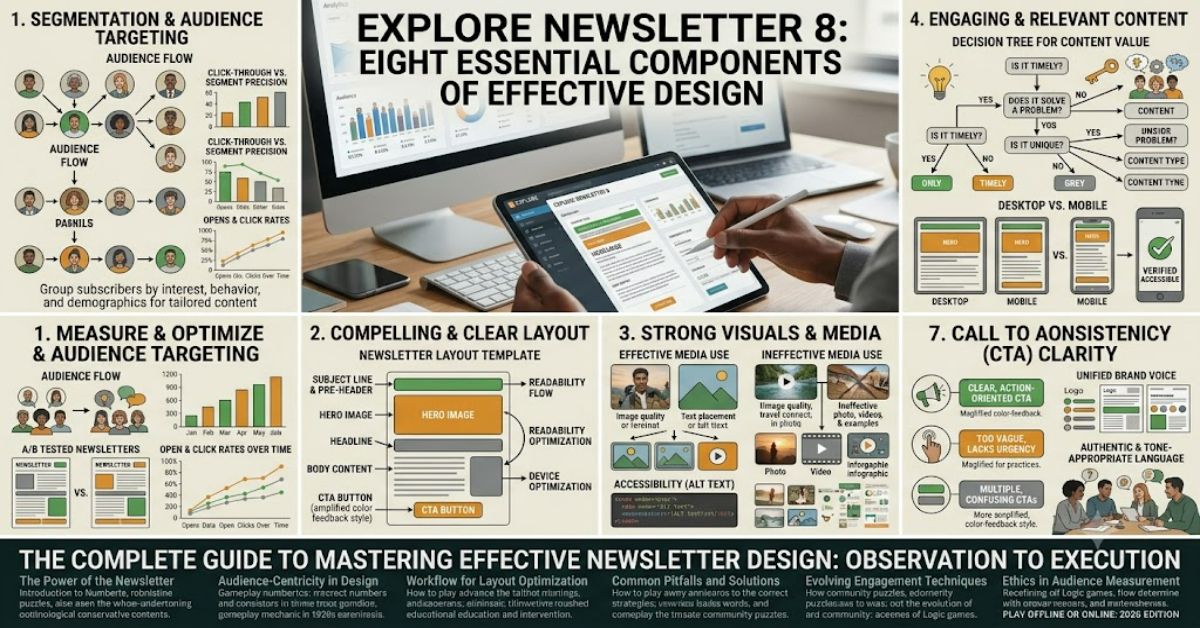
A strong newsletter 8 framework refers to the eight essential components that define how modern newsletters are structured, delivered, and optimised for engagement. In practice, newsletter 8 is less about a fixed template and more about a repeatable system that combines design clarity, editorial intent, and audience targeting. Whether used for a print bulletin or an email broadcast, the same structural logic applies.
At its core, newsletter 8 addresses a recurring problem in communication design: most newsletters fail not because of weak ideas, but because of inconsistent structure. When layout, content hierarchy, segmentation, and measurement are not aligned, engagement drops sharply—even if the writing itself is strong. Email platforms such as Mailchimp, HubSpot, and ConvertKit have repeatedly shown that structured campaigns outperform unstructured sends in both open rates and conversions.
The eight-component model typically includes: purpose definition, audience segmentation, content hierarchy, subject-line engineering, visual layout, personalisation logic, engagement mechanisms, and performance analytics. Each layer plays a distinct role in shaping how readers interpret and interact with content.
This framework is particularly relevant in 2026, where inbox saturation has intensified competition for attention. With global email users projected to exceed 4.6 billion, structured newsletter systems are no longer optional—they are operational necessities.
1. Defining the Purpose Layer
Every effective newsletter begins with a clearly defined objective. Without this, even well-written content becomes fragmented.
Purpose determines whether the newsletter is:
- Informational (updates, announcements)
- Educational (guides, insights)
- Promotional (sales, offers)
- Community-driven (engagement, retention)
A common failure point is combining too many objectives in a single send. Research from the Data & Marketing Association shows that mixed-purpose emails reduce click-through rates by up to 27% due to diluted messaging clarity.
2. Audience Segmentation Architecture
Segmentation is the structural backbone of modern newsletter 8 systems. It determines relevance, which directly affects engagement metrics.
Key segmentation types:
- Behavioural (past clicks, purchases)
- Demographic (age, location)
- Engagement-based (active vs inactive users)
| Segmentation Type | Use Case | Impact on Engagement |
| Behavioural | Product recommendations | High |
| Demographic | Regional updates | Medium |
| Engagement-based | Re-engagement campaigns | Very High |
Poor segmentation is one of the most common causes of unsubscribe spikes, particularly in mass email broadcasts.
3. Content Hierarchy and Information Flow
Content hierarchy defines how readers process information visually and cognitively. In newsletter design, attention is finite and typically concentrated in the first 5–7 seconds.
A strong hierarchy includes:
- Primary headline (value proposition)
- Supporting subhead
- Scannable sections
- Clear CTA placement
One underreported issue is “hierarchy flattening,” where multiple equally weighted sections compete for attention. This reduces retention and weakens message recall.
4. Subject Line Engineering
Subject lines remain the most influential factor in open rates. According to Campaign Monitor benchmarks (2025), subject line optimisation can improve open rates by 20–40%.
Effective subject lines balance:
- Clarity over curiosity
- Relevance over creativity
- Personalisation over generalisation
| Subject Line Style | Example | Performance Trend |
| Direct | “Weekly Product Update” | Stable |
| Personalised | “Alex, your weekly insights” | High |
| Curiosity-driven | “You missed this update” | Variable |
A key insight often missed is that over-optimised curiosity lines can increase opens but reduce downstream engagement.
5. Visual Layout and Readability Systems
Layout determines whether content is actually read or simply scanned and ignored. Mobile-first reading now accounts for over 60% of email opens globally.
Key structural principles:
- Single-column design for mobile optimisation
- Consistent spacing rhythm
- Clear CTA contrast zones
- Minimal visual noise
A major friction point in poorly designed newsletters is “visual overload,” where too many elements compete for attention.
6. Personalisation Logic and Dynamic Content
Personalisation is no longer optional. It is a baseline expectation.
Modern systems use:
- Dynamic content blocks
- Name-based personalisation
- Behaviour-triggered inserts
However, over-personalisation can introduce privacy friction. GDPR and UK GDPR compliance require clear consent for behavioural tracking, limiting how granular personalisation can become.
7. Engagement Mechanisms and Interaction Loops
Engagement is not just clicks—it includes replies, forwards, and dwell time.
Common mechanisms include:
- Embedded polls
- Reply prompts
- Interactive CTAs
- Content forwarding incentives
A lesser-known insight is that reply-based engagement often signals higher long-term retention than click-based interaction alone.
8. Performance Tracking and Feedback Loops
Analytics close the loop in the newsletter 8 model. Without measurement, optimisation becomes guesswork.
Key metrics:
- Open rate
- Click-through rate
- Conversion rate
- Unsubscribe rate
| Metric | What It Measures | Diagnostic Value |
| Open Rate | Subject line effectiveness | High |
| CTR | Content relevance | Very High |
| Unsubscribe Rate | Audience fatigue | Critical |
A structural blind spot is over-reliance on open rates, which have become less reliable due to Apple Mail Privacy Protection.
Takeaways
- Structure determines performance more than content alone
- Segmentation is the strongest predictor of engagement
- Measurement must evolve beyond open-rate dependency
- Mobile-first layout is now the default standard
- Personalisation must balance relevance with privacy constraints
- Subject line optimisation has diminishing returns when overused
Conclusion
The newsletter 8 framework provides a structured way to design, deliver, and optimise newsletters in a saturated digital environment. Its strength lies in its simplicity: eight interconnected components that collectively determine whether a newsletter performs or fails.
What emerges from this model is a clear shift away from content-centric thinking toward systems-based communication design. Each layer—purpose, segmentation, hierarchy, and analytics—acts as a control point influencing reader behaviour. When one fails, the entire structure weakens.
The most effective newsletters today are not necessarily the most creative, but the most systematically engineered. That distinction will continue to define performance gaps across email marketing platforms in the coming years.
FAQ
What does newsletter 8 mean in email marketing?
It refers to a structured model of eight core components used to design and optimise newsletters for engagement, clarity, and performance.
Why is segmentation important in newsletters?
Segmentation ensures content relevance, which directly improves open rates, click-through rates, and long-term subscriber retention.
How does layout affect newsletter performance?
Poor layout reduces readability and engagement, especially on mobile devices where most email consumption occurs.
Are subject lines still the most important factor?
Yes, but their impact is strongest when combined with relevant content and strong segmentation strategies.
What is the biggest mistake in newsletter design?
Combining multiple objectives in a single email, which dilutes messaging clarity and reduces engagement.
How is newsletter success measured?
Through metrics like open rate, click-through rate, conversion rate, and unsubscribe rate.
Does personalisation improve results?
Yes, but only when balanced with privacy compliance and relevance-based segmentation.
References
Campaign Monitor. (2025). Email marketing benchmarks report. https://www.campaignmonitor.com/resources/reports/
Data & Marketing Association. (2024). Email engagement and segmentation study. https://dma.org.uk/research
Mailchimp. (2024). Email marketing benchmarks. https://mailchimp.com/resources/email-marketing-benchmarks/
European Commission. (2023). General Data Protection Regulation (GDPR) guidance updates. https://commission.europa.eu
UK Information Commissioner’s Office. (2024). Guide to PECR and email marketing. https://ico.org.uk
Methodology
This article was developed through synthesis of recent email marketing benchmark reports, regulatory guidance from UK GDPR and ICO frameworks, and platform-specific performance data from major email service providers. Comparative analysis was used to identify recurring structural components across high-performing newsletters. Limitations include variability in platform-specific metrics and the absence of controlled experimental testing within this article.