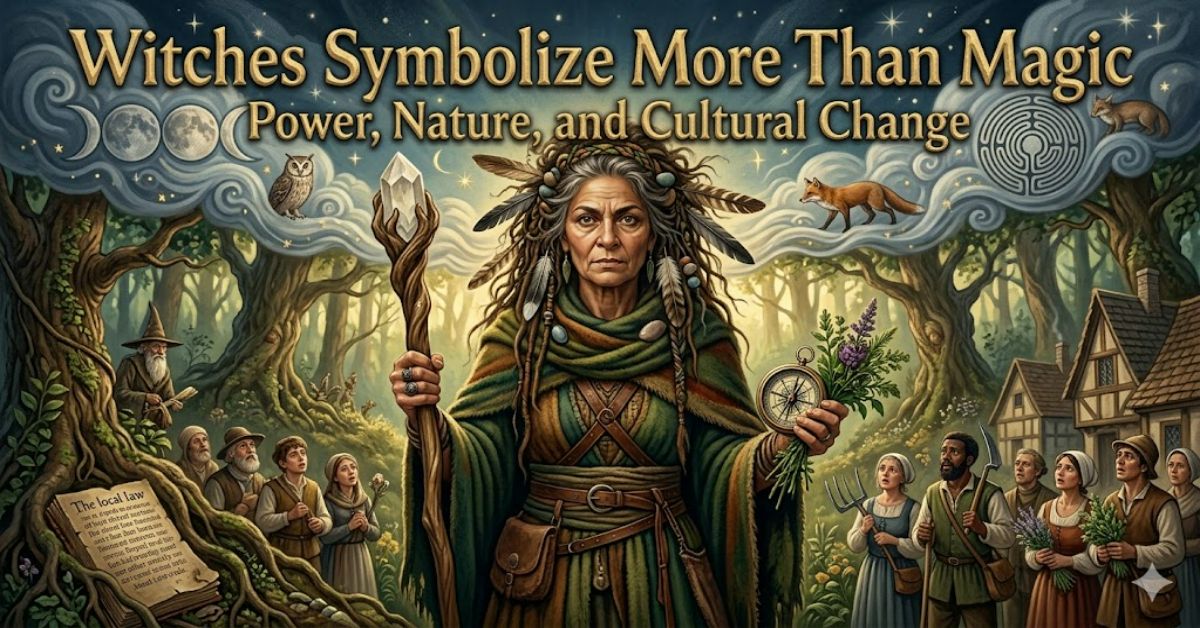
When people ask what witches symbolize, they are often surprised by how many different answers exist. Across history, literature, folklore, religion, art, and popular culture, witches have represented everything from danger and disorder to wisdom, healing, feminine power, and personal freedom. Their symbolism has never been fixed. Instead, it has evolved alongside society’s attitudes toward authority, gender, spirituality, and the natural world.
Historically, witches were frequently portrayed as threats to religious and social order. During the European witch trials of the fifteenth through eighteenth centuries, accusations often targeted individuals who lived outside accepted norms or possessed knowledge that communities did not fully understand. Over time, however, cultural interpretations changed. By the late twentieth century and into the twenty-first century, the witch increasingly emerged as a symbol of empowerment, autonomy, and resistance.
This transformation makes the witch one of the most fascinating symbolic figures in Western culture. Unlike many archetypes that retain a consistent meaning, the witch continuously adapts to the concerns of each era. Today, witches appear in films, literature, fashion, political activism, social media movements, and contemporary spiritual practices.
Understanding what witches symbolize requires examining both historical realities and modern reinterpretations. Their meaning lies not only in folklore but also in society’s changing relationship with power, identity, and belief itself.
The Historical Origins of Witch Symbolism
Before examining contemporary meanings, it is important to understand how witch symbolism developed.
Throughout European history, accusations of witchcraft were often linked to fear of the unknown. Communities facing illness, crop failures, economic hardship, or social instability frequently sought explanations for events they could not control.
As a result, the figure of the witch became associated with:
- Hidden knowledge
- Supernatural influence
- Social deviance
- Religious anxiety
- Female independence
Historical records from European witch hunts reveal that many accused witches were women who occupied unusual social positions or challenged accepted expectations. This connection between perceived nonconformity and witchcraft accusations continues to influence modern interpretations.
Witches as Symbols of Independent Female Authority
Perhaps the most widely recognised modern interpretation is the witch as a symbol of female autonomy.
Historically, women who possessed knowledge, influence, or independence sometimes attracted suspicion. Midwives, healers, widows, and women living outside traditional family structures could become targets during periods of social tension.
Today, many scholars and cultural commentators view the witch as a symbol of resistance to patriarchal control. Rather than representing evil, the witch represents a woman exercising authority without requiring validation from existing power structures.
Why This Symbolism Endures
The endurance of this symbolism reflects broader cultural questions:
- Who is allowed to hold power?
- How does society respond to unconventional authority?
- Why are independent women sometimes portrayed differently than independent men?
These questions help explain why the witch remains culturally relevant centuries after the major witch trials ended.
Witches and the Symbolism of Nature
Another central answer to the question of what witches symbolize involves humanity’s relationship with nature.
In folklore and modern spiritual traditions, witches are often connected to:
- Forests
- Herbs
- Lunar cycles
- Seasonal changes
- Animal companions
- Traditional healing practices
This imagery reflects a worldview in which humans exist within natural systems rather than above them.
Nature Versus Industrial Modernity
An overlooked aspect of witch symbolism is how it often serves as a counterbalance to technological and industrial society.
Modern audiences frequently interpret witches as representing:
| Symbolic Theme | Meaning |
| Forests | Untamed wisdom |
| Herbs | Traditional knowledge |
| Moon cycles | Natural rhythms |
| Animal familiars | Human-nature connection |
| Seasonal rituals | Ecological awareness |
This association helps explain why environmental and sustainability movements occasionally adopt witch-related imagery.
Wisdom, Healing, and Hidden Knowledge
Across many traditions, witches symbolize knowledge that exists outside formal institutions.
Historically, folk healers often preserved practical understanding of plants, remedies, and local customs. Although modern medicine has replaced many traditional practices, cultural memory still associates witches with healing and specialised knowledge.
Importantly, this symbolism is not necessarily about supernatural powers.
Instead, it often reflects:
- Experience-based learning
- Community knowledge
- Intuition
- Observation of natural systems
This interpretation has become increasingly common in contemporary storytelling and popular culture.
Comparison Table: Traditional vs Modern Witch Symbolism
| Aspect | Historical Interpretation | Modern Interpretation |
| Power | Threatening | Empowering |
| Knowledge | Dangerous | Valuable |
| Nature | Unpredictable | Harmonious |
| Independence | Suspicious | Celebrated |
| Spirituality | Heretical | Personal exploration |
| Community Role | Outsider | Alternative guide |
This shift demonstrates how cultural symbols evolve alongside social values.
The Witch as a Symbol of Resistance
One of the most significant developments of the past fifty years has been the political use of witch symbolism.
Activists, artists, and writers have increasingly adopted the witch as a metaphor for resistance against systems perceived as unjust.
The symbolism works because the witch occupies a unique position:
- Marginalised but powerful
- Feared but resilient
- Independent but connected to community
Historical examples include feminist protest movements that deliberately embraced witch imagery to critique social inequalities and challenge traditional power structures.
Why Popular Culture Keeps Reimagining Witches
The popularity of witches in books, television, film, and fashion is not accidental.
Witches are unusually adaptable symbols.
Unlike heroes who often represent clear moral positions, witches occupy a more complex space between:
- Good and evil
- Order and chaos
- Nature and civilisation
- Individuality and conformity
This flexibility allows each generation to reinterpret them according to contemporary concerns.
Modern Examples
Recent cultural portrayals increasingly emphasise:
- Self-discovery
- Personal empowerment
- Spiritual exploration
- Community building
- Ecological awareness
These themes differ dramatically from the fear-based depictions common centuries ago.
Three Often-Missed Insights About Witch Symbolism
1. Witches Symbolize Society’s Relationship With Outsiders
The meaning of the witch often reveals more about society than about witches themselves.
When societies fear outsiders, witches become villains. When societies value individuality, witches become heroes.
2. Witch Symbolism Changes During Periods of Social Uncertainty
Periods of political, economic, or cultural change frequently produce renewed interest in witch imagery.
This pattern appears repeatedly throughout history.
3. Nature Symbolism Explains Modern Popularity
Many analyses focus exclusively on feminism or spirituality.
However, growing environmental concerns have also strengthened the appeal of witch symbolism because witches are frequently portrayed as living in harmony with natural systems.
Structured Insight Table
| Symbol | Traditional Meaning | Contemporary Meaning |
| Broomstick | Domestic association | Freedom and movement |
| Cauldron | Mystery and magic | Transformation and creativity |
| Black Cat | Omen or familiar | Intuition and independence |
| Forest | Danger and wilderness | Nature and renewal |
| Moon | Supernatural influence | Cycles and self-reflection |
Many iconic witch symbols originated from ordinary household or natural objects that gradually acquired deeper cultural meanings.
The Future of Witch Symbolism in 2027
Looking toward 2027, several trends suggest witch symbolism will continue evolving.
Digital Spirituality
Online communities have expanded access to folklore, mythology, and alternative spiritual traditions.
Environmental Awareness
As climate concerns remain prominent, symbols associated with nature and ecological balance may gain further cultural significance.
Continued Feminist Reinterpretation
The witch is likely to remain an important figure in discussions surrounding gender, authority, and representation.
Cultural Complexity
Future portrayals will probably become more nuanced, recognising the historical realities of witch persecutions while exploring contemporary themes of empowerment and identity.
The precise direction remains uncertain, but evidence suggests the witch will continue functioning as a flexible cultural symbol rather than a fixed archetype.
Takeaways
- Witch symbolism has transformed significantly over several centuries.
- Independent authority remains one of the strongest modern associations.
- Nature, healing, and ecological awareness are increasingly important themes.
- Popular culture continuously reshapes the meaning of witches.
- The witch often reflects society’s treatment of outsiders and nonconformists.
- Modern interpretations emphasise empowerment more than fear.
- Future symbolism will likely continue blending spirituality, environmentalism, and cultural critique.
Conclusion
The question of what witches symbolize cannot be answered with a single definition. Their meaning has changed repeatedly across history, reflecting broader shifts in culture, religion, politics, and social values.
Historically, witches represented fear of the unknown and anxiety about individuals who challenged accepted norms. Over time, however, that symbolism evolved. Today, witches are more commonly associated with independence, wisdom, resilience, healing, and a connection to nature. They have become powerful cultural figures precisely because they embody contradictions. They can be both feared and admired, traditional and revolutionary, spiritual and political.
The enduring appeal of the witch lies in this flexibility. Each generation discovers new meaning within the archetype. Whether viewed through folklore, feminism, environmental awareness, literature, or popular culture, witches continue to offer insight into society’s deepest concerns about power, identity, and belonging.
Far from disappearing, witch symbolism remains one of the most adaptable and revealing cultural symbols of the modern era.
FAQ
What do witches symbolize in modern culture?
In modern culture, witches often symbolize empowerment, independence, personal freedom, spiritual exploration, and resistance to restrictive social norms.
Why are witches associated with female power?
Historical witch accusations disproportionately targeted women, particularly those who lived independently or possessed specialised knowledge. Modern interpretations often view witches as symbols of female authority and self-determination.
Do witches symbolize nature?
Yes. Witches are frequently associated with forests, herbs, animals, seasonal cycles, and ecological awareness, making them powerful symbols of humanity’s connection to nature.
Why are witches portrayed as outsiders?
Many historical witch narratives focused on individuals who existed outside mainstream social expectations. As a result, witches became enduring symbols of nonconformity and individuality.
What does a witch’s broom symbolize?
The broom originally represented domestic life but later evolved into a symbol of freedom, transformation, and movement through folklore and popular culture.
Why has witch symbolism become more positive?
Changing social attitudes toward gender, spirituality, and personal identity have encouraged reinterpretations that emphasise empowerment rather than fear or persecution.
Methodology
This article synthesises historical scholarship, cultural analysis, folklore research, and contemporary interpretations of witch symbolism. Historical context was cross-referenced against established sources discussing European witch hunts, folklore traditions, and modern cultural representations.
Limitations include the diversity of witch traditions across different cultures and time periods. No single interpretation can fully represent all historical or contemporary understandings of witches. The article therefore focuses on dominant symbolic themes found within Western cultural traditions while acknowledging ongoing reinterpretation.
Editorial Disclosure
This article was drafted with AI assistance and should be reviewed and verified by the editorial team at RubbleMagazine.co.uk before publication. All citations, references, and historical claims should be independently checked against primary and scholarly sources.
References (APA Style)
Pruitt, S. (2020). Why do witches ride brooms? The history behind the legend. History. https://www.history.com/articles/why-witches-fly-on-brooms
Rizzo, J. (2024). How broomsticks, cauldrons, and pointy hats became essential witch gear. National Geographic.
Yuko, E. (2023). Why do witches wear pointy hats? The history behind the costume. History.
De Graaff, R. (2026). The meanings behind famous witchcraft symbols explained. TheCollector.
Hartless, J., & Smith, G. V. (2025). From “Born This Witch” to “Bad Bitch Witch”. In The Witch Studies Reader. Duke University Press.