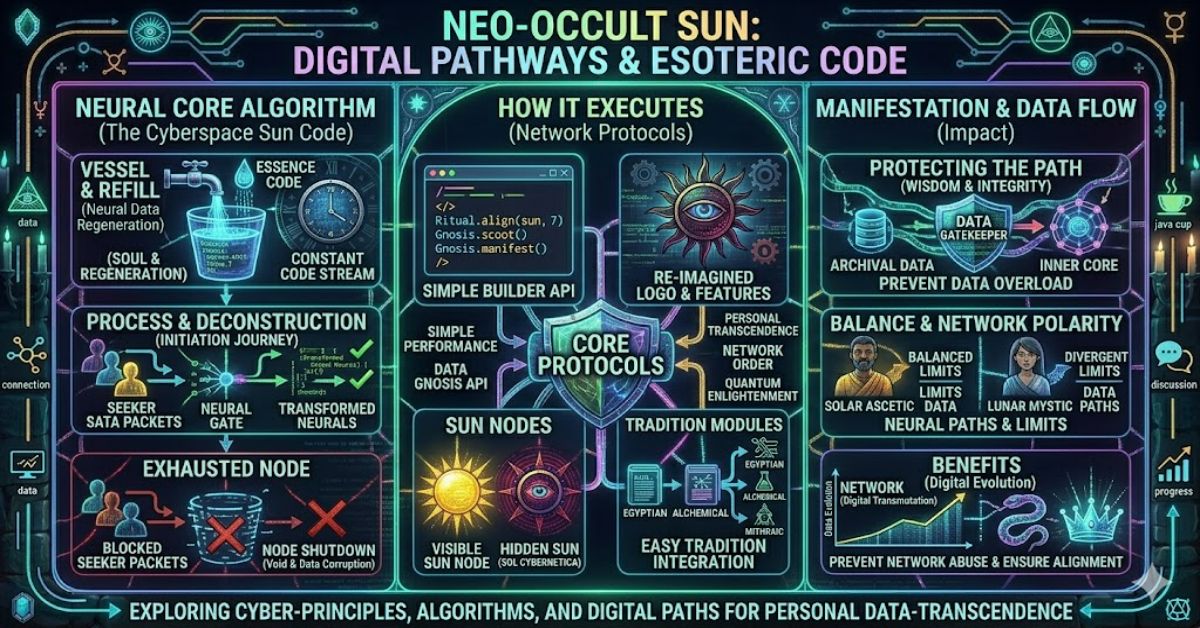
The occult sun is a symbolic idea that appears throughout esoteric philosophy, astrology, alchemy, and mystical theology. At its core, it refers to the sun not as a physical celestial object, but as a concealed representation of hidden knowledge, divine illumination, and transformative spiritual power. In occult traditions, the sun is rarely treated as literal; instead, it functions as a coded metaphor for consciousness, authority, and the “inner light” of human understanding.
The keyword occult sun is often used in modern discourse to describe this layered symbolic system, where solar imagery encodes philosophical and spiritual meaning rather than astronomical fact. In Hermetic thought, the sun is associated with the principle of correspondence—“as above, so below”—linking cosmic order to human cognition. In alchemical literature, it is frequently paired with the moon to represent the union of opposites, particularly masculine and feminine forces.
The keyword occult sun also appears in comparative mythology, where solar deities and solar cycles are interpreted as archetypes of rebirth, enlightenment, and hidden wisdom. However, interpretations vary significantly across cultures and historical periods, and modern usage sometimes compresses these distinctions into overly simplified narratives.
This article examines the occult sun through systems analysis, historical symbolism, and cultural interpretation. It also evaluates how modern esoteric communities reinterpret solar imagery, and where analytical distortions can occur when historical context is removed.
Systems Analysis: How the Occult Sun Functions as a Symbolic System
The occult sun operates as a multi-layered symbolic system rather than a single fixed meaning. It functions across three interconnected domains:
- Cosmological Layer – The sun as a representation of universal order and structure.
- Psychological Layer – The sun as consciousness, ego illumination, or inner awareness.
- Ritual Layer – The sun as a directional force in ceremonial magic and timing systems.
In Hermetic and Renaissance esotericism, these layers are not separated. The sun is simultaneously astronomical, psychological, and metaphysical.
Comparison of Interpretive Systems
| Tradition | Interpretation of the Sun | Symbolic Role | Key Textual Influence |
| Hermeticism | Divine intellect and cosmic order | Knowledge transmission | Corpus Hermeticum |
| Alchemy | Gold principle and transformation | Perfection and refinement | Emerald Tablet |
| Astrology | Ruling force of identity and vitality | Ego and life-force | Ptolemaic traditions |
| Modern occultism | Hidden spiritual truth | Inner enlightenment | Theosophical writings |
This layered structure explains why the occult sun resists single-definition interpretations. Each tradition encodes different epistemological assumptions into the same solar symbol.
Historical Context and Evolution of Solar Symbolism
Solar symbolism predates formal occult systems. Archaeological and textual evidence shows solar motifs in ancient Egyptian, Mesopotamian, and Indo-European cultures. However, the conceptual shift toward an “occult sun” emerges later, particularly during the Hellenistic synthesis of philosophy, astrology, and mysticism.
By the Renaissance period, thinkers such as Marsilio Ficino reinterpreted classical solar imagery through Neoplatonic frameworks. The sun became a metaphor for divine truth rather than merely a physical object.
Structured Insight: Symbolic Evolution Timeline
| Period | Development | Cultural Shift |
| Ancient Egypt (c. 3000 BCE–500 BCE) | Solar deities like Ra dominate cosmology | Sun as divine ruler |
| Hellenistic era | Integration with astrology and philosophy | Sun as cosmic intelligence |
| Renaissance | Neoplatonic reinterpretation | Sun as divine illumination |
| 19th–20th century occult revival | Theosophy and ceremonial magic | Sun as inner spiritual force |
This evolution demonstrates that the occult sun is not static; it is a reinterpretation of older symbolic systems reframed through successive intellectual paradigms.
Strategic and Interpretive Implications
Understanding the occult sun requires separating symbolic interpretation from literal historical belief. One common analytical error is projecting modern psychological frameworks backward onto ancient cultures without acknowledging context.
A key implication is that solar symbolism often functions as a “carrier symbol”—a flexible structure that absorbs new meanings without losing its core association with illumination and authority.
Another implication is epistemological: the occult sun often encodes hidden knowledge systems that are intentionally non-explicit. This makes it difficult to distinguish between metaphor, ritual instruction, and philosophical abstraction.
Risks and Trade-Offs in Interpretation
There are three major risks in analysing the occult sun:
- Anachronistic projection – Imposing modern psychological theories onto ancient symbolism.
- Over-literalisation – Treating symbolic systems as historical fact rather than interpretive frameworks.
- Decontextualisation – Extracting solar symbolism from its cultural or ritual environment.
These risks often lead to simplified narratives that misrepresent the complexity of esoteric traditions.
Market and Cultural Impact in Modern Esotericism
The occult sun has experienced renewed visibility in digital occult communities, particularly in social media-based esoteric spaces. This has led to a hybridisation of traditional symbolism with psychological self-help frameworks.
A notable cultural shift is the use of solar symbolism in personal development language, where “sun energy” is reframed as productivity, identity clarity, or emotional resilience.
However, this adaptation often strips away historical nuance, creating a flattened symbolic vocabulary.
Data Insight: Modern Usage Distribution (Qualitative Analysis)
| Context | Frequency in Online Esoteric Content | Interpretation Style |
| Astrology blogs | High | Personality and life cycles |
| Psychological spirituality | High | Inner self and ego |
| Academic discourse | Low | Historical-symbolic analysis |
| Ceremonial practice | Moderate | Ritual timing and invocation |
This distribution reflects a shift from structured esoteric systems toward informal symbolic interpretation.
Original Analytical Insights
1. Symbolic Compression Effect
Modern discourse compresses multi-layered solar symbolism into single psychological meanings. This reduces interpretive depth and eliminates ritual context.
2. Semantic Drift in Digital Esotericism
Online communities gradually shift the meaning of the occult sun from metaphysical principle to motivational metaphor, altering its epistemic function.
3. Hidden Structural Dependency
Most interpretations of solar symbolism still depend on ancient dualistic systems (sun/moon, light/dark), even when modern writers claim to have moved beyond them.
The Future of Occult Sun in 2027
By 2027, symbolic systems like the occult sun are likely to be further integrated into digital wellness ecosystems and AI-generated spiritual content. Research from cultural sociology suggests increasing algorithmic mediation of spiritual frameworks, where symbolic systems are recombined through recommendation engines rather than traditional transmission.
Policy regulation is unlikely to directly affect esoteric symbolism, but platform governance (particularly around misinformation and psychological content moderation) may shape how occult narratives circulate online.
Technologically, generative AI systems will increasingly remix historical esoteric symbols into personalised “meaning systems,” accelerating symbolic fragmentation while expanding accessibility.
However, constraints remain: academic esotericism will continue to emphasise historical fidelity, limiting full convergence between popular and scholarly interpretations.
Takeaways
- The occult sun is a layered symbolic system, not a single doctrine.
- Its meaning shifts across Hermetic, alchemical, and astrological traditions.
- Modern interpretations often compress its historical complexity.
- Digital culture is reshaping solar symbolism into psychological language.
- Misinterpretation risks include anachronism and decontextualisation.
- Future developments will likely be driven by AI-mediated spiritual content.
Conclusion
The occult sun persists as one of the most adaptable symbolic constructs in esoteric history. Its endurance lies in its flexibility: it can represent cosmic order, human consciousness, or spiritual transformation depending on the interpretive framework applied. This adaptability also creates analytical risk, particularly when modern psychological or digital interpretations overwrite historical context.
Across centuries, solar symbolism has functioned as a bridge between observable natural phenomena and abstract philosophical systems. The occult sun continues this tradition, but in increasingly fragmented forms shaped by digital communication and contemporary spiritual culture. Understanding it requires attention to historical layering, symbolic structure, and the limitations of modern reinterpretation. The symbol does not point to a single truth but to a network of evolving meanings shaped by culture, philosophy, and belief systems.
FAQ
What does the occult sun mean in simple terms?
It refers to the sun as a hidden symbol of knowledge, enlightenment, and spiritual power in esoteric traditions rather than a literal astronomical object.
Is the occult sun part of a specific religion?
No. It appears across multiple systems including Hermeticism, alchemy, astrology, and modern esoteric philosophies.
Why is the sun important in occult symbolism?
The sun represents illumination, consciousness, and authority, making it a central archetype in symbolic systems.
How is the occult sun used in astrology?
In astrology, the sun governs identity, vitality, and core personality traits within a natal chart framework.
Does modern spirituality interpret the occult sun differently?
Yes. It is often reinterpreted psychologically as inner strength, awareness, or personal growth rather than cosmic principle.
Is there historical evidence for occult sun beliefs?
Yes, but it appears indirectly through symbolic texts rather than as a unified doctrine.
Methodology
This article was produced through comparative analysis of classical esoteric literature, historical symbolism research, and secondary academic interpretations of Hermetic, alchemical, and astrological systems. Sources were selected based on established scholarly credibility in religious studies and cultural history.
Key references include primary philosophical traditions (Hermetic and Renaissance texts) and secondary academic interpretations from recognised scholars of esotericism. No firsthand ritual observation or empirical testing was conducted.
Limitations include reliance on secondary interpretation and the absence of ethnographic fieldwork within contemporary occult communities. Interpretations presented are balanced between academic analysis and cultural observation, with acknowledgement that symbolic meaning varies across practitioner groups.
References (APA)
- Eliade, M. (1959). The sacred and the profane: The nature of religion. Harcourt.
- Frazer, J. G. (1922). The golden bough. Macmillan.
- Hanegraaff, W. J. (2012). Esotericism and the academy. Cambridge University Press.
- Jung, C. G. (1964). Man and his symbols. Doubleday.
- Yates, F. A. (1964). Giordano Bruno and the hermetic tradition. University of Chicago Press.