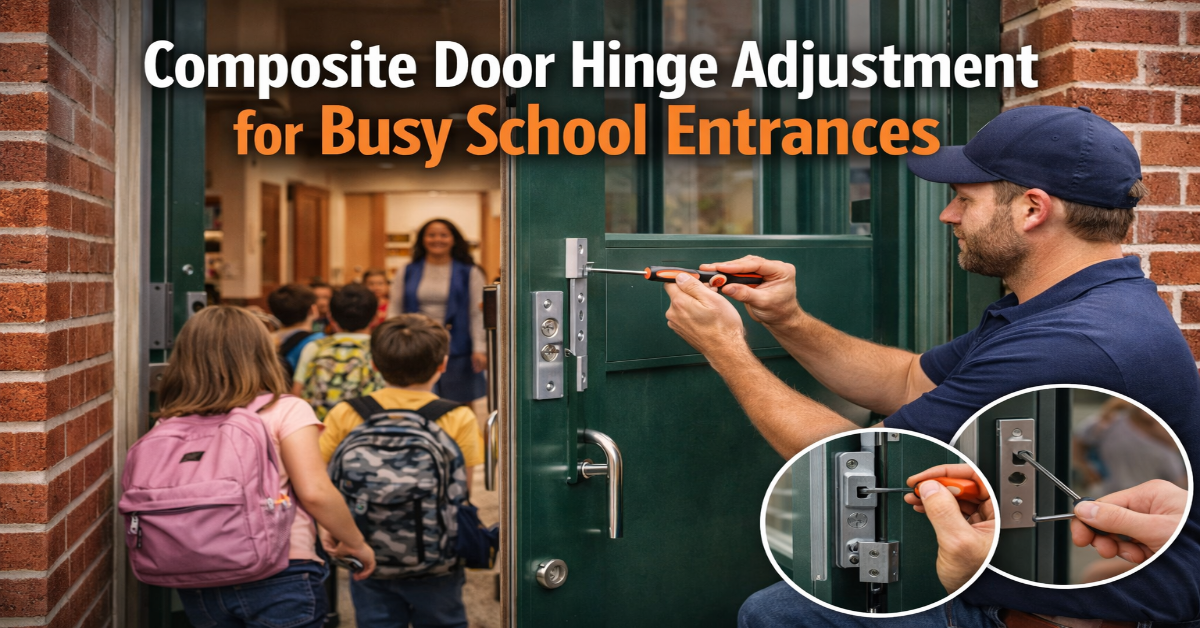
Of all the doors in a school setting, the school entrance is by far and away the most likely to wear out. Why? Well, it is the most commonly used door. School entrances stay open longest and tend to be the doors opened and closed the most during the year. As such, it should come as no surprise that you might need a composite door hinge adjustment. Hinges on school entrances come under intense scrutiny as the year goes on; no wonder they start sticking or making noises when they are opened!
To help you understand how to fix this problem, we reached out for assistance from ironmongery experts at Locks & Hardware. As experts in door security and functionality, they noted to us that the most likely problem is with the door hinges. If a hinge starts to loosen or becomes out of line, it could lead to the door sticking or failing to open correctly. When that happens, what can you do?
Most of the time, your school maintenance team can fix this problem with a screwdriver, an Allen key and a spirit level. If they are unable to fix the issue, call a locksmith, and they can restore order to the door.
Why Do School Entrances Run Into Hinge Problems?
The simple answer? Wear and tear. Any door will eventually begin to find that its hinges become under pressure. They could corrode, become loose, or fall out of alignment, leaving the door sagging. When that happens, you can find that your school entrances begin to become a bit problematic. They might fail to open properly, or they could stick and jam as you try to open them.
In the UK, hinge problems can even be caused by the door swelling. Swelling indoors happens for all manner of reasons, but most of the time it is environmental. The school could slightly subside, or the constant expansion and contraction of the door brought on by annual weather changes could see the hinges loosen or fall out of line.
Generally, though, the main reason is down to wear and tear. These doors are used more than any other in the school building; the entrance is, after all, the main way in and out of the school. From morning assembly to get the kids in school to break time, lunch time, PE, and home time, school entrance doorways can come under a lot of scrutiny.
Most schools in the UK use composite doors of varying sizes. No matter the size of the door, adjusting door hinges remains a fairly universal task. Let’s take a look at what you need to do here.
Adjustment Solutions For High-Traffic School Entrance Doors
Now that you understand why adjusting door hinges could be needed, where do you start? Let’s take a quick look.
Please note that this only covers some of the issues you might face; if the problem with your school entrance persists after these tips, contact a locksmith. The issue could be more severe than just a hinge that needs to be adjusted.
- Start by cleaning your door hinges; sometimes, the problems are caused by nothing more than dirt build-up or debris blocking the hinge!
- Lubricate your hinges, too, using a silicone-based lubricant if possible. This should be done twice per year to keep doors resistance-free.
- The problem could also be down to the sealant around the door. If the sealant has been broken, it could be causing the door to stick.
More likely, though, the problem is going to come down to one of two hinge problems: loose screws or alignment issues.
Composite Door Hinge Adjustment For Height
Sometimes, the problem revolves around the fact that the door is no longer level with the frame or the building itself.
This can be fixed by locating the height adjustment screw; for most composite door hinges, this will be near the bottom. To turn this screw, you will need an Allen key. The screw might be hidden behind a cap, which will need to be temporarily removed using a screwdriver to pop it off safely.
Simply rotate the screw in a clockwise manner to raise the door upward, or counterclockwise if the door needs to be lowered. This should only take a few moments; for certainty that your door is level, use a spirit level. This will help you to understand whether or not the door is aligned.
Be sure to check the floor at the school entrance for signs of the floor raising, too; the problem might lie here as opposed to with the door. Lastly, check the door with a quick test to see if the door still fights against you when opened/closed.
Adjusting Door Hinges With Loose Screws
The other likely issue is that the hinges have become loose. Screws can be adjusted with much the same process as the above, but it is likely that you will be looking for a screw on the side of the hinge as opposed to the bottom of the hinge.
Try adjusting each screw around the hinge in the same clockwise/counterclockwise direction. This will either tighten the screw and make it feel sturdier or loosen it if you go counterclockwise. Sometimes, the screw can be wound too tightly and give the door little room for opening.
Again, test this by opening the door and closing it over again. If you still feel like the door is catching or making screeching noises as you open or close it, the problem might be beyond a basic composite door hinge adjustment.
Make Routine Hinge Checks A Priority
Any school maintenance team would do well to make checking hinges at least twice per year a goal. This is a simple way to make sure that doors are opening smoothly, ensuring easy opening and closing. There are also the security benefits of knowing that your doors are secure; loose hinges or misaligned doors are easier to break through for people looking to vandalise your school property.
Routine hinge care – twice per year or as soon as a problem is noticed/reported – should be a priority. This can keep doors working for longer and reduce the risk of anything from a security flaw to a potential fire hazard if the door sticks during an evacuation.