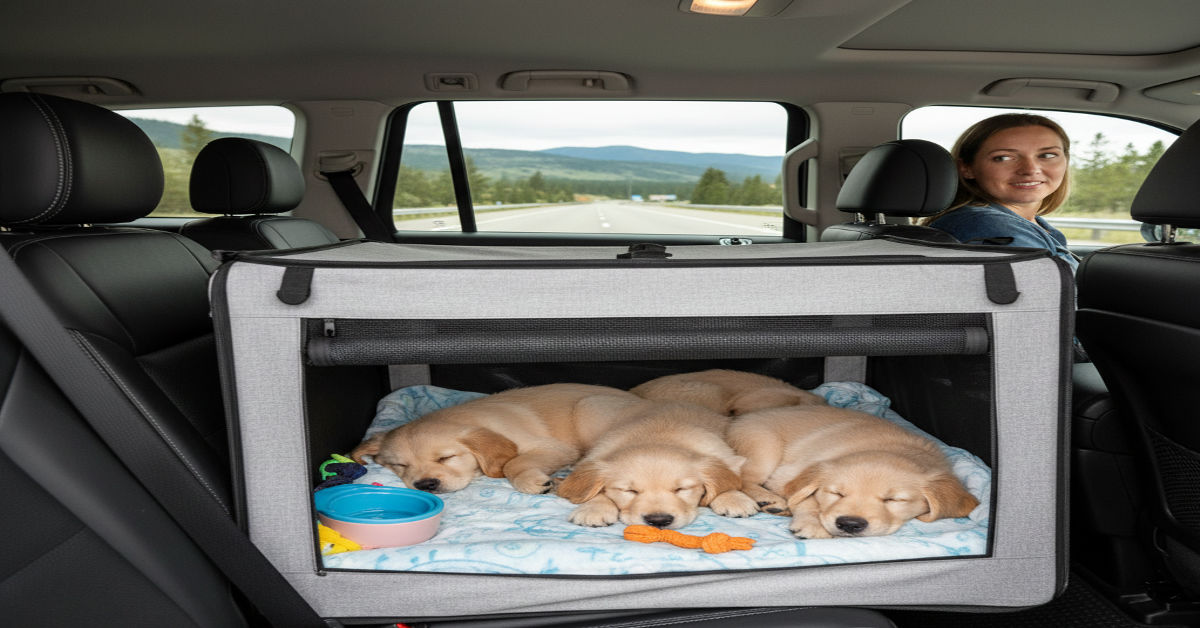
Pets aren’t called “pets” for nothing. They need care and attention from the people who have taken on not just animals, but responsibility for them. The question of protection and care for puppies becomes especially acute during long journeys and the need to transport animals in a car. But we have several tips for you and your pets!
Secure the animal
Reliable restraint of the puppy during ground transport is the first guarantee of safety. After all, if the animal can move freely, there are risks of it getting under the pedals, on the driver’s hands or face, etc. In any case, this can lead to an accident. So first and foremost: make sure the animal is secured in the car cabin! How to do this?
It all depends on the animal.
Puppies can be transported in a carrier box. Moreover, the latter can be installed on the floor in the car cabin or easily secured even with standard seat belts.
Small/medium-sized dogs or large cats already require purchasing a restraint (for paws/chest area/back) or a larger soft box that’s installed and secured with belts on the passenger seat.
A large dog needs even more space for transportation. We’re talking about a trunk with a mesh partition to limit access to the cabin or setting up a large box in the back row of seats – essentially, the back seats will be completely occupied. Various transport boxes are sold in pet stores.
Place the animal in the cabin or trunk
A few words about where to place your pet in the car cabin. Actually, it all depends not only on the size of the animal, but also on the type of car body.
The simplest and best option is a car with a “hatchback” or “station wagon” body. In this case, you can remove the cargo cover and place the animal in the trunk. The necessary temperature will be maintained there, there will be contact with the cabin and the owner-people, plus you can keep the second-row seats free for passengers.
A more difficult option is a car with a “sedan” body. In this case, we recommend folding part of the seat back to ensure good air circulation and the possibility of visual/auditory contact between the animal and the owner-people.
Don’t let your pet stick their head out the car windows
If the dog is riding in the car cabin and in an open box, make sure it can’t look out the side window. Like they draw in all those happy pictures – actually, that’s not very good.
First, when moving at high speed, small stones or insects can hit the dog’s nose or eyes. It will be painful and unpleasant, serious injuries are even possible.
Second, even ordinary air, but constantly blowing into the eyes and ears, can cause diseases like runny nose, various swelling, etc.
Third, the dog might suddenly jump out the window, reacting to a stimulus on the other side of the road. And here you are driving, lots of cars around, and the dog jumps under their wheels and tries to cross the road.
Fourth: the animal might first stick its head out, then accidentally press the window button with its paw and start raising the window. So there’s a risk of strangulation.
So in this case the advice is simple: only lower the window slightly (this will be enough for ventilation) and lock the window control buttons on the driver’s door panel. Or better yet, put the dog in the center of the back seat.
Don’t feed the animal before the trip to avoid motion sickness
The previous advice is also important to prevent the animal from getting motion sick during a long journey. After all, flickering objects in the side window can lead to the dog or cat getting sick. Instead, it’s better for the animal to look forward, see a more uniform view of the terrain ahead, like the driver and front passenger see. This reduces the risks of your pet getting sick during a long journey. Proper positioning can be achieved with boxes and restraints we mentioned above.
How else to avoid the animal getting motion sick on the road? Most importantly – already 2-3 hours before the start of the journey, don’t feed the dog or cat. Better spend this time walking in the fresh air. But water must be given, because drinking is needed more often. Especially during the hot summer period.
Ensure comfortable temperature and air circulation
In general, maintaining the temperature regime is very important for the comfort of not only people but also animals. So prepare the car for the trip in advance, start the engine and warm up/cool down the cabin to the desired temperature. This way it will be comfortable for both you and your pet.
In addition, not only the air temperature is important, but also the supply of fresh air. For this, you can keep the windows slightly open. When moving at high speed, this will already be enough for good air circulation. But remember our previous advice: don’t open the window too much so the dog can’t stick its head out. Better crack open any other window where there’s no one nearby.
And of course: don’t leave the animal for long in a completely closed cabin under the scorching sun. Conditionally speaking, you have a maximum of a few minutes to refuel the car at a gas station or use the bathroom. If you need more time, either take your pet with you or leave the ventilation/air conditioning system running in the cabin.
Let them get used to the car interior
For any animal, going beyond comfortable and familiar living conditions is stressful. So give your dog/cat some time to get used to the car interior. Open the car doors, let the animal in. Let them walk around the cabin, smell the car, find a comfortable place. During this time, you don’t need to immediately close the car doors, because the animal will again feel like it’s in a closed and unknown cage and might get scared.
Getting puppies used to the car interior will be helped by favorite things: a toy or blanket, a sleeping pillow, etc. So take 1-2 things with you into the cabin that will remind them of the usual living environment of your pet.
In addition, the owners’ voices will help calm the animal. You need puppies to communicate and talk with your pet. This way there will be a feeling that the closest person is nearby, everything is under control. The best option is placing the animal in the back seat together with one of the owners. Then everyone will be calmer and more comfortable.
Drive smoothly, make stops for rest and walks
By the way, calm is the key word when driving a car: in general, and especially in the case of traveling with an animal. After all, any sudden acceleration or braking, high speed, sharp turns can scare the animal and end with unpredictable consequences: running around the cabin, jumping out onto the street through the window, etc.
Instead, it’s better to go outside on puppies schedule, during stops every 2-3 hours. This is needed both by the driver – to rest, stretch, drink water or coffee, use the bathroom – and by the animal, which has similar requests and wishes.
Before long routes, start with short ones
Finally, the last piece of advice preparing for an especially long puppies journey or possible trip abroad. A long journey starts with small ones go on car rides with the animal, gradually increasing the time – one hour, then two or three, then even more with an intermediate stop. Also during the journey, you can feed the animal a little with their favorite food. We’re not talking about feeding on a full stomach now (remember, they might get sick), but specifically about treats – this will be like a reward for the journey.
And if the final puppies destination of the journey will be another country, then find out the entry rules and prepare for this in advance. You may need to get additional vaccinations and/or arrange a veterinary passport for your pet.