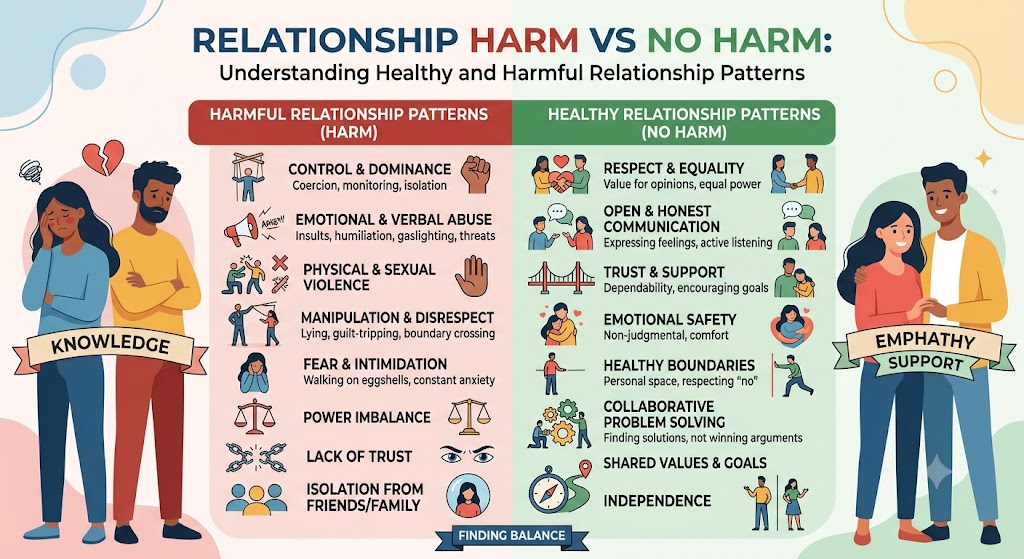
Understanding relationship harm vs no harm is essential for recognising whether a partnership supports emotional wellbeing or creates ongoing distress. Healthy relationships are not defined by the absence of disagreements; instead, they are shaped by how people handle conflict, communicate needs, and repair emotional ruptures. Partners may sometimes hurt each other’s feelings, but respectful relationships allow accountability, forgiveness, and growth.
Harmful relationships follow a different pattern. They often involve repeated control, emotional manipulation, fear, isolation, or behaviours that gradually reduce a person’s sense of confidence and independence.
The challenge is that harmful dynamics are not always obvious at the beginning. Many unhealthy relationships contain positive moments alongside damaging behaviour, making it difficult to identify the overall pattern. Looking at consistency, power balance, and emotional impact provides a clearer way to understand the difference.
What Defines a Healthy Relationship?
A healthy relationship is based on psychological safety. This means both people feel able to express opinions, set boundaries, and communicate honestly without fear of punishment or retaliation.
Key characteristics include:
- Mutual respect: Both partners value each other’s feelings, choices, and personal boundaries.
- Trust: Partners believe each other’s words and actions without excessive monitoring.
- Emotional support: Difficult moments are approached with compassion rather than criticism.
- Shared responsibility: Both people contribute to maintaining the relationship.
- Conflict repair: Arguments are followed by discussion, accountability, and attempts to improve.
Research into relationship psychology highlights that successful couples are not those who never disagree. Instead, they are often those who develop healthier methods of managing disagreements.
Understanding Harmful Relationship Patterns
Harmful relationships are usually identified through repeated patterns rather than a single mistake.
A person may experience relationship harm when their partner regularly:
- Controls who they spend time with.
- Uses guilt or fear to influence decisions.
- Dismisses their feelings.
- Creates emotional instability.
- Prevents independence.
- Uses insults, threats, or intimidation.
An important distinction is frequency and impact. Everyone can behave poorly during moments of stress. However, harmful dynamics become concerning when negative behaviours become a repeated system rather than an isolated incident.
Relationship Harm vs No Harm: Key Differences
| Healthy Relationship Patterns | Harmful Relationship Patterns |
| Open communication | Fear-based communication |
| Respect for boundaries | Attempts to control behaviour |
| Apologies followed by change | Repeated apologies without improvement |
| Independence is encouraged | Isolation from friends and family |
| Conflict leads to understanding | Conflict creates fear or punishment |
The difference is not whether problems exist. Every relationship faces challenges. The difference is whether those challenges are handled with care or used as opportunities for control.
The Role of Emotional Safety
Emotional safety is one of the strongest indicators of relationship quality.
A person experiencing emotional safety can usually:
- Share concerns without being mocked.
- Express disagreement without fear.
- Ask for support when struggling.
- Maintain their own identity outside the relationship.
When emotional safety disappears, people often begin changing their behaviour to avoid conflict. They may constantly monitor their words, apologise excessively, or hide their feelings.
This gradual adjustment can affect confidence and mental wellbeing over time.
Conflict, Repair, and Relationship Growth
Conflict itself is not automatically harmful.
Healthy couples experience disagreements because two individuals naturally have different needs, opinions, and expectations. The important factor is what happens afterwards.
Healthy conflict repair may include:
- Listening to each other’s perspective.
- Accepting responsibility.
- Finding practical solutions.
- Changing future behaviour.
In contrast, harmful conflict often follows a cycle where one person causes distress, minimises the impact, and repeats the same behaviour without meaningful change.
Hidden Risks People Often Miss
Several relationship problems are overlooked because they develop slowly.
| Hidden Risk | Why It Matters |
| Gradual isolation | Reduces outside support systems |
| Normalising disrespect | Makes unhealthy behaviour appear acceptable |
| Confusing intensity with love | Strong emotions do not always indicate security |
| Avoiding difficult conversations | Allows problems to become permanent patterns |
One of the most overlooked issues is that occasional kindness does not automatically cancel repeated harm. Positive moments can exist within unhealthy relationships, which is why patterns matter more than individual events.
The Future of Relationship Awareness in 2027
By 2027, discussions around relationship health are likely to continue expanding through education, digital resources, and improved awareness of emotional wellbeing.
Technology will make relationship information more accessible, but digital tools cannot replace professional support or personal judgement. A major challenge will be distinguishing reliable relationship education from oversimplified online advice.
Future conversations are likely to focus more on emotional literacy, boundary-setting, and recognising unhealthy patterns earlier.
Key Takeaways
- Healthy relationships are built on trust, respect, and emotional security.
- Conflict is normal; harmful conflict patterns are the concern.
- Repeated control and manipulation are warning signs.
- Emotional safety is central to long-term relationship wellbeing.
- Positive moments do not erase ongoing harmful behaviour.
- Understanding patterns helps people make clearer decisions.
Conclusion
The difference between relationship harm vs no harm is not perfection. Every partnership experiences disagreements, misunderstandings, and difficult periods. What separates supportive relationships from damaging ones is the presence of respect, accountability, and emotional safety.
Harmful dynamics often develop through repeated patterns that affect confidence, independence, and wellbeing. Recognising these patterns requires looking beyond individual moments and considering the overall impact of the relationship.
A healthy relationship allows both people to grow while maintaining their identity and dignity. When trust, respect, and repair disappear, the relationship may move into a damaging cycle that requires serious attention.
Understanding these differences gives people a clearer framework for evaluating their relationships and recognising what genuine emotional support looks like.
FAQ
What is the difference between relationship harm and normal conflict?
Normal conflict involves disagreements that can be repaired through communication and respect. Relationship harm involves repeated behaviours that damage wellbeing or create fear.
Can a healthy relationship still cause hurt feelings?
Yes. Healthy partners can hurt each other’s feelings, but they usually acknowledge the impact and work towards repair.
What are common signs of a harmful relationship?
Common signs include control, manipulation, isolation, intimidation, repeated disrespect, and ignoring personal boundaries.
Why is emotional safety important in relationships?
Emotional safety allows people to communicate honestly, express needs, and maintain their individuality without fear.
Can harmful relationship patterns change?
Change is possible when there is genuine accountability, willingness to improve, and consistent behavioural change over time.
References
- Gottman, J. M., & Silver, N. (2015). The Seven Principles for Making Marriage Work. Harmony Books.
- World Health Organization. (2021). Violence against women: Intimate partner and sexual violence. WHO.
- UK Government. (2023). Domestic abuse: statutory guidance framework. GOV.UK.
Editorial Disclosure:
This article was drafted with AI assistance and should be reviewed and verified by the RubbleMagazine.co.uk editorial team before publication.