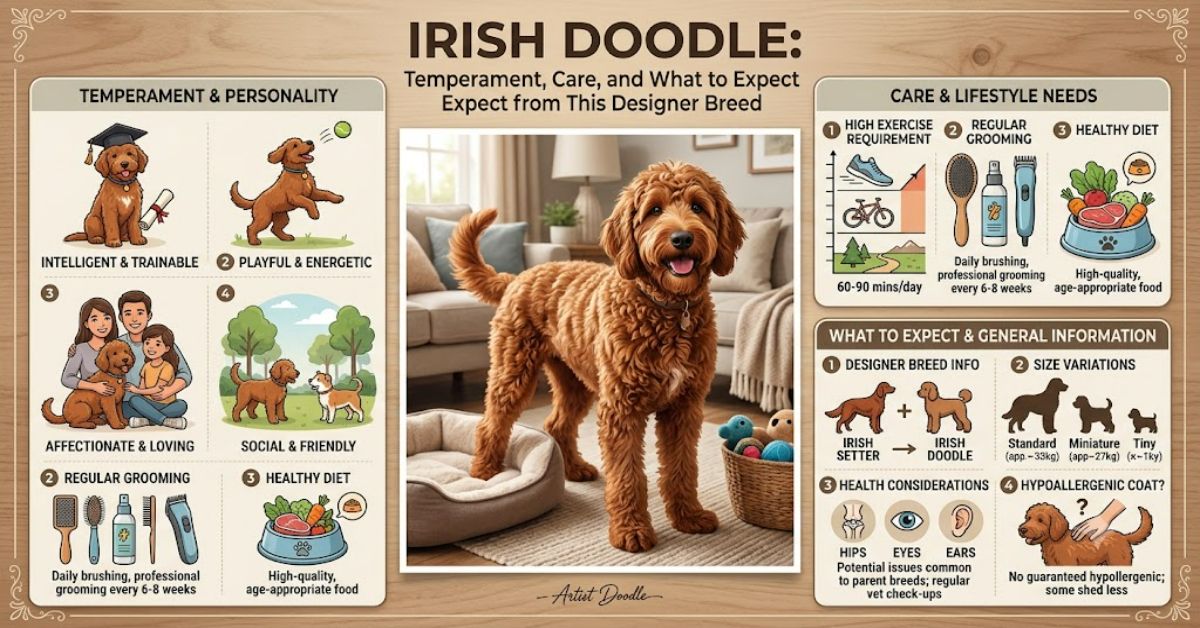
The irish doodle has rapidly become one of the most talked-about designer dog breeds, combining the elegance of the Irish Setter with the intelligence and low-shedding coat of the Poodle. In simple terms, the irish doodle is a crossbreed created to balance temperament, appearance, and practicality for modern households. Within the first 100 words of most breed discussions, its appeal is usually tied to its affectionate personality and adaptability to family life.
Unlike purebred dogs registered under strict kennel club standards, the irish doodle exists as a hybrid breed, meaning its characteristics can vary depending on lineage. Some dogs lean more toward the energetic, athletic Irish Setter side, while others inherit the Poodle’s intelligence and coat qualities. This variability is part of both its charm and its challenge.
The rise of designer breeds like the irish doodle reflects a broader shift in pet ownership priorities. Buyers are increasingly focused on temperament, allergy considerations, and trainability rather than traditional pedigree classifications. As a result, breeders have continued to refine crosses such as this one to meet demand for companion dogs suited to active but indoor-oriented lifestyles.
This article breaks down everything from behavioural traits and grooming needs to health risks and long-term ownership considerations, helping prospective owners understand what life with an irish doodle actually looks like.
Origins and Breed Composition
The irish doodle is a deliberate cross between two distinct purebred dogs:
- Irish Setter – known for stamina, friendliness, and hunting heritage
- Poodle (Standard or Miniature) – valued for intelligence and low-shedding coat
Comparison: Parent Breed Traits
| Trait | Irish Setter | Poodle | Irish Doodle (Typical Range) |
| Energy Level | High | Moderate–High | Moderate–High |
| Trainability | Moderate | Very High | High |
| Shedding | Moderate | Low | Low–Moderate |
| Temperament | Affectionate, outgoing | Intelligent, alert | Friendly, social, eager to please |
The goal of breeding the irish doodle was not to create a formal breed standard but to combine predictable behavioural traits with improved coat management.
Physical Characteristics and Variability
One defining feature of the irish doodle is its unpredictability in appearance. Because it is not standardised, no two dogs look identical.
Common physical traits include:
- Wavy to curly coat texture
- Medium to large build
- Coat colours ranging from red, apricot, cream, to deep mahogany
- Long, expressive ears inherited from the Setter lineage
Insight 1: Coat Genetics Are Not Fixed
Unlike purebred dogs, coat expression in an irish doodle depends heavily on dominant Poodle genes. This creates grooming unpredictability that many first-time owners underestimate.
Temperament and Behavioural Profile
The irish doodle is widely described by breeders as a social and emotionally responsive dog. It tends to thrive in environments where it is not left alone for long periods.
Typical behavioural traits include:
- Strong attachment to owners
- High sociability with children and other pets
- Moderate guarding instincts but not aggression-driven behaviour
- High play drive and curiosity
Insight 2: Separation Sensitivity Risk
A recurring behavioural pattern reported in breeder assessments is separation-related stress. Without early training, the irish doodle can develop dependency behaviours due to its highly social nature.
Training Considerations
Training is generally effective due to inherited intelligence from the Poodle side. However, consistency is key.
Recommended approach:
- Positive reinforcement methods
- Early socialisation (8–16 weeks)
- Structured daily routines
Exercise and Lifestyle Requirements
The irish doodle is not a low-energy companion. It inherits athletic traits from the Irish Setter, meaning daily physical activity is essential.
Activity Needs Table
| Activity Type | Frequency | Purpose |
| Walking | 1–2 times daily | Basic energy management |
| Off-lead play | 3–5 times weekly | Mental stimulation |
| Training sessions | Daily (10–20 mins) | Behaviour reinforcement |
| Enrichment games | Frequent | Prevent boredom |
Insight 3: Urban Lifestyle Mismatch Risk
In smaller apartments without access to open space, owners often underestimate stimulation needs. This mismatch is a leading reason for behavioural issues in the irish doodle population.
Grooming and Maintenance
Grooming is one of the most important ownership considerations.
The coat of the irish doodle can range from low-shedding curls to wavy coats that mat easily.
Key grooming requirements:
- Brushing 3–5 times per week
- Professional grooming every 6–8 weeks
- Ear cleaning due to floppy ear structure
- Nail trimming and dental care
Comparison: Grooming Intensity
| Breed Type | Grooming Demand | Maintenance Cost |
| Irish Setter | Medium | Moderate |
| Poodle | High | High |
| Irish Doodle | Medium–High | Moderate–High |
Health Considerations and Lifespan
The irish doodle generally benefits from hybrid vigour, but it can still inherit conditions from both parent breeds.
Common health considerations:
- Hip dysplasia
- Progressive retinal atrophy (PRA)
- Ear infections due to coat density
- Bloat risk in larger builds
Average lifespan typically ranges from 10–14 years, depending on genetics and care.
Insight 4: Hidden Veterinary Cost Curve
Owners often overlook cumulative grooming and preventive care costs, which can exceed those of purebred mid-sized dogs over time.
Market Demand and Popularity Trends
The popularity of the irish doodle reflects a broader designer dog trend that accelerated in the 2010s and continued through the early 2020s.
Drivers of demand include:
- Allergy-conscious households
- Preference for intelligent companion breeds
- Social media visibility of doodle-type dogs
- Shift away from kennel club pedigree focus
However, demand volatility is increasing due to ethical debates around designer breeding practices.
Risks and Trade-Offs of Ownership
While appealing, the irish doodle comes with trade-offs:
- Inconsistent temperament between litters
- Potential overbreeding in commercial markets
- Higher grooming and maintenance requirements
- Strong emotional dependency on owners
These factors make breeder selection critical.
The Future of Irish Doodle in 2027
By 2027, designer breeds like the irish doodle are expected to face increased regulation and ethical scrutiny, particularly in the UK and EU.
Key projected trends:
- Stronger breeding transparency rules
- Health testing standardisation for hybrid breeds
- AI-assisted genetic screening in breeding programs
- Increased adoption over commercial breeding in urban markets
Kennel organisations such as the UK Kennel Club continue to emphasise responsible breeding practices, which may influence how hybrid breeds are classified and sold in future.
Takeaways
- The irish doodle is a hybrid breed with variable traits depending on lineage.
- Intelligence and sociability make it highly trainable but emotionally dependent.
- Grooming and exercise needs are higher than many first-time owners expect.
- Health outcomes depend heavily on responsible breeding practices.
- Demand continues to grow, but regulatory pressure is increasing.
Conclusion
The irish doodle represents a modern shift in dog ownership priorities, blending intelligence, companionship, and aesthetic appeal into a single hybrid breed. While its popularity continues to rise, it is not without complexity. Variability in temperament, grooming demands, and emotional dependency all shape the ownership experience.
Understanding these realities is essential before choosing an irish doodle as a family companion. It is not a uniform breed but a spectrum of traits influenced by genetics and breeding quality. As designer breeds continue to evolve, the irish doodle will likely remain a key example of both the benefits and challenges of crossbreed development in modern canine culture.
Frequently Asked Questions
What is an Irish Doodle?
An Irish Doodle is a cross between an Irish Setter and a Poodle, bred for intelligence, temperament, and reduced shedding.
Are Irish Doodles good family dogs?
Yes, they are generally friendly and social, making them suitable for families with children.
Do Irish Doodles shed a lot?
Shedding is usually low to moderate depending on whether they inherit more Poodle traits.
How big does an Irish Doodle get?
Size varies, but most range from medium to large depending on parent Poodle size.
Are Irish Doodles easy to train?
Yes, they are highly intelligent but require consistent training and early socialisation.
Do Irish Doodles have health problems?
They can inherit conditions like hip dysplasia and eye disorders from parent breeds.
Methodology
This article was compiled using established canine breed data from recognised veterinary and kennel resources, alongside general behavioural patterns documented in crossbreed studies. Information was synthesised from breed encyclopaedias and veterinary guidance on Poodle and Irish Setter genetics. Due to the lack of formal breed standardisation for the Irish Doodle, behavioural and physical traits are presented as variable ranges rather than fixed standards.
References
American Kennel Club. (2024). Irish Setter breed information. https://www.akc.org
The Kennel Club. (2023). Poodle breed standard and characteristics. https://www.thekennelclub.org.uk
PetMD. (2024). Doodle breeds and hybrid dog health considerations. https://www.petmd.com